Revealing how crabs make their escape
Houdini-like Neohelice granulata offers a rare opportunity to record intracellularly from awake, behaving animals.
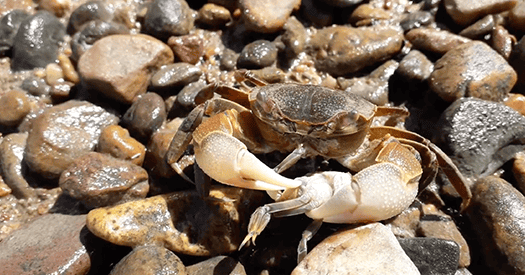
Neohelice granulata, commonly known as the mud crab, exhibits remarkable escape abilities, providing researchers with a unique opportunity to study intracellular activity in awake, behaving animals. Found along the coast of Argentina, these crabs burrow into sand estuaries and marshes. Daniel Tomsic, a neuroscience professor at the University of Buenos Aires, grew up witnessing the crabs scuttle away from perceived threats.
Tomsic is now investigating how the crab's ganglia regulate visually guided escape behavior, focusing on the creatures' interactions with gulls, which prey upon them. These crabs, measuring slightly larger than a guitar pick, must decide whether to flee and in which direction upon spotting a gull overhead. Tomsic likens this decision-making process to that of a tennis player anticipating and reacting to a powerful serve.
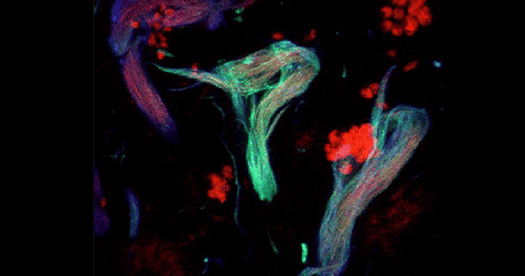
The crabs' ability to perform time-to-collision calculations remains unknown, but Tomsic's work, guided by his mentor Hector Maldonado, who introduced Neohelice as a model organism in Argentina, is shedding light on this mystery. Tomsic's method of making intracellular recordings in live, behaving crabs—unprecedented in insects—has provided invaluable insights into the circuits connecting visual input to motor output.
The decision to flee is triggered once the approaching object reaches a certain size, with the crab's running speed continuously adjusted as the threat grows.
A single giant neuron, MLG2, encodes the rate of threat expansion and drives speed adjustments in real-time, while MLG1 controls freezing responses. Field studies by Tomsic and his colleague Jan Hemmi, a professor of biological sciences at the University of Western Australia, have revealed that crabs behave differently in laboratory settings than in their natural habitats.
In the lab, crabs consistently flee in the opposite direction from an approaching stimulus and only move when the threat is large enough, while in the wild, they quickly bolt in response to smaller threats and hide in their burrows, even if in the same direction as a predator. Tomsic emphasizes the importance of field studies in validating laboratory findings, as misinterpreting natural behavior without field checks can lead to significant errors.
Written by urgent.news from The Transmitter's reporting — not their text. Machine-written — may contain errors; check the original before relying on it.
This story
This is one outlet's version. Read the fullest account.
- Revealing how crabs make their escape thetransmitter.org