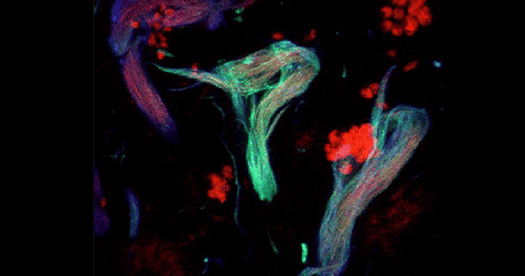
Revealing how crabs make their escape
Houdini-like Neohelice granulata offers a rare opportunity to record intracellularly from awake, behaving animals.
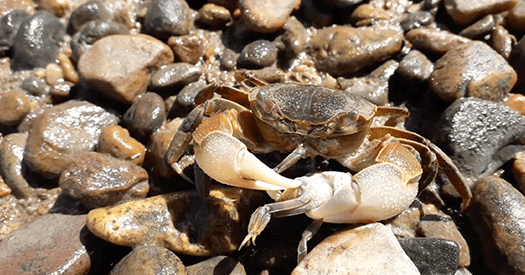
Neohelice granulata, also known as the mud crab, demonstrates remarkable escape abilities that provide a unique opportunity for neuroscientific research. Found along the coasts of Argentina in estuaries and salt marshes, these crabs frequently dig into the sand. Daniel Tomsic, a neuroscience professor at the University of Buenos Aires, has dedicated his study to understanding how the crabs' ganglia control visually guided escape behavior.
These crabs, only slightly larger than a guitar pick, must decide when to flee from predators like gulls. When a gull is spotted, the crab must quickly compute the time until collision, a task similar to a tennis player anticipating a powerful serve. Intracellular recordings from live, behaving crabs have revealed the neural circuits that connect visual input to motor output.
The decision to flee is initiated when an object's apparent size reaches a certain threshold. The speed of the crab's movement adjusts in real-time according to the size of the threat, slowing down if the stimulus ceases to grow. One giant neuron, MLG2, encodes the rate at which the threat is approaching and controls the crab's speed, while another neuron, MLG1, governs a freezing response.
Research conducted by Tomsic and colleagues has shown that laboratory conditions lead crabs to flee in the opposite direction from an approaching stimulus, and they only move when the stimulus is quite large. However, in their natural environment, crabs react more quickly to smaller threats and retreat to their burrows to avoid predators.
This discrepancy underscores the importance of field studies in validating laboratory findings. Tomsic is now exploring how the presence of other crabs influences individual escape decisions and investigating predatory behavior using the mud crab model.
Written by urgent.news from The Transmitter's reporting — not their text. Machine-written — may contain errors; check the original before relying on it.
Also reported by 1 other outlet
- Revealing how crabs make their escape thetransmitter.org