NASA launches new space telescope
NASA has successfully launched its newest space telescope from the Kennedy Space Center in Florida. The telescope reached orbit just 10 minutes after liftoff and is now beginning its mission to shed light on some of the universe’s biggest unsolved mysteries. Named after astronomer Nancy Grace Roman, the telescope is being hailed by scientists as a “discovery machine.”
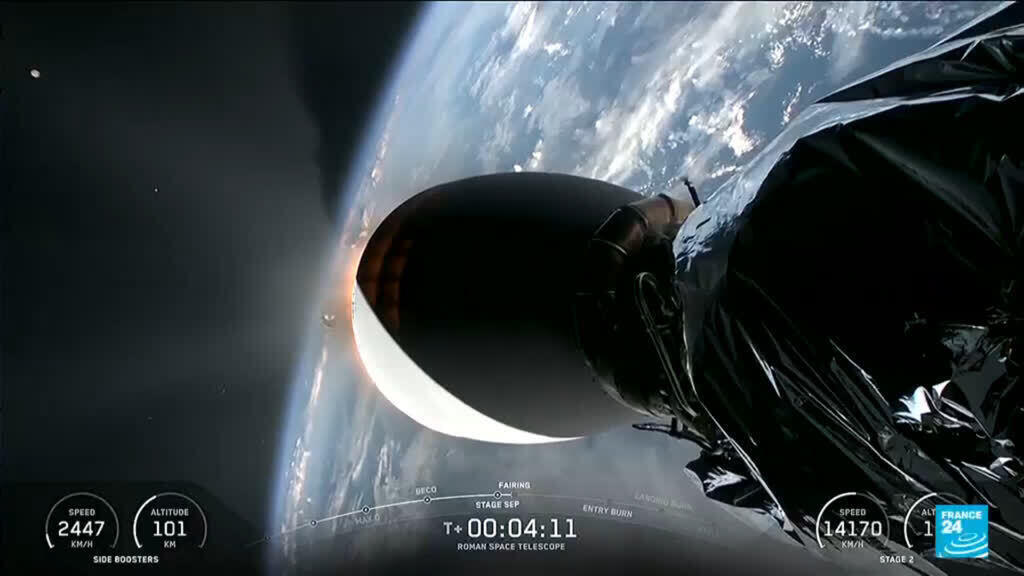
NASA is set to launch the Nancy Grace Roman Space Telescope on August 30, 2026, alongside the Hubble and James Webb Space Telescopes. One of its primary objectives is to discover and map distant planets outside our Solar System, known as exoplanets. Currently, there are only 6,200 exoplanets identified, but it is anticipated that the Roman telescope's observations will significantly increase this number, thanks to its efficient survey capabilities.
Upon its initial five-year mission, scientists expect the Roman telescope to discover up to 100,000 new exoplanets, ranging from gas giants similar to Jupiter to smaller, icy worlds with up to one-tenth the mass of Earth. The telescope will employ three methods to identify these distant worlds: transits, microlensing, and direct imaging.
The first method, transits, is currently the most effective way to detect new planets. Roman will identify exoplanets by measuring the brief dips in starlight that occur when a planet passes in front of its host star, blocking some of its light. However, Roman may struggle to discover smaller planets, which is where the second method, microlensing, comes in.
This technique takes advantage of the fact that massive stars can bend starlight, causing temporary increases in brightness when another, more distant star passes between the observer and the first star. By observing these microlensing events, Roman can detect planets orbiting the second star, even if they are as small as Mars.
The final method, direct imaging, will utilize Roman's powerful technology to capture high-resolution images of dusty disks surrounding nearby stars. The telescope's advanced Coronagraph, a system of optics, masks, mirrors, and sensors, will block starlight and allow scientists to directly observe exoplanets and their debris disks.
With a sensitivity a thousand times greater than other observatories, Roman's Coronagraph will be instrumental in discovering giant exoplanets and helping researchers develop technologies for imaging Earth-like worlds in the future.
Written by urgent.news from Discover Magazine's reporting — not their text. Machine-written — may contain errors; check the original before relying on it.
This story
This is one outlet's version. Read the fullest account.
- NASA’s Roman Telescope Takes Aim at Cosmic Mysteries bloomberg.com
- NASA’s Roman Space Telescope Launches on Mission to Probe Hidden Universe sci.news
- NASA launches Roman telescope on cosmic mapping mission nst.com.my
- NASA's Nancy Grace Roman Space Telescope Launches to Find Exoplanets and Unravel Mysteries of Dark Matter and Dark Energy smithsonianmag.com
- Nasa launches new space telescope able to see 100 times more than Hubble bbc.co.uk
- NASA's Roman Telescope Could Unravel the Mysteries of Dark Energy and Dark Matter discovermagazine.com
- Nasa launches Roman telescope on cosmic mapping mission freemalaysiatoday.com