Astronomers Discover the Existence of a Black Hole Star
An object observed by the James Webb Space Telescope lends credence to a strange explanation for the mysterious red spots in the early universe.
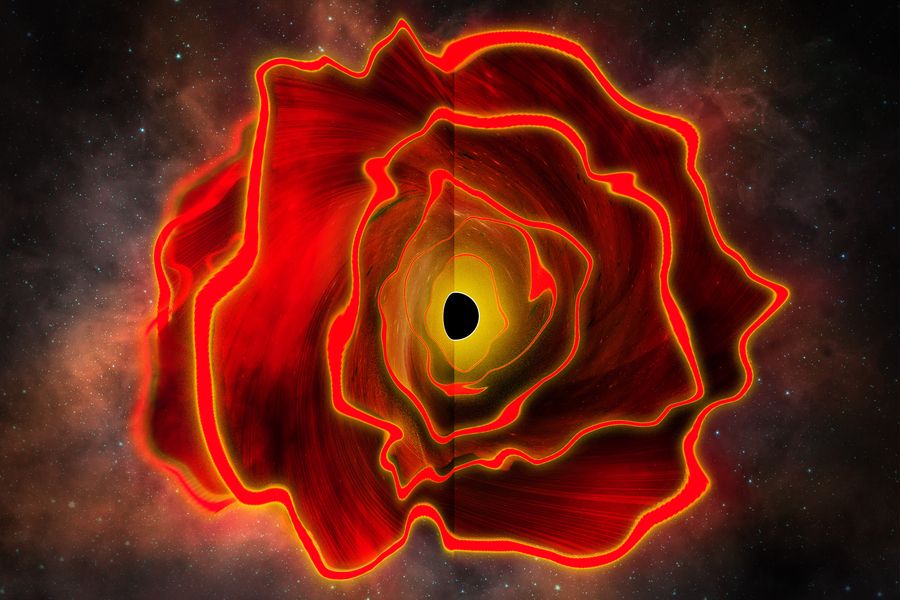
Astronomers have unveiled compelling evidence of a "black hole star" in a new study published in Nature. Utilizing data from the James Webb Space Telescope, researchers observed an object dubbed MoM-BH*-1, which appears as a large red spot in the early universe. This cosmic phenomenon exhibits curious properties, such as emitting 100 billion times more energy than typical stars and displaying an unusually intense light absorption.
Scientists now believe MoM-BH*-1 is a black hole shrouded in a dense gas envelope, with the black hole at its core devouring matter and releasing immense energy. The immense energy eventually passes through the gas before escaping, acquiring characteristics similar to starlight. This discovery sheds light on another mystery uncovered by the telescope, as numerous small red spots in the early universe have perplexing origins.
Black hole stars could potentially explain these enigmatic objects, as they appear to dominate their surrounding galaxies, appearing as pure black hole light. The study's lead author, Rohan Naidu, highlights that MoM-BH*-1's black hole essentially outshines its host galaxy, providing a unique opportunity to study the fundamental nature of these hypothetical cosmic entities.
Written by urgent.news from Wired's reporting — not their text. Machine-written — may contain errors; check the original before relying on it.
This story
This is one outlet's version. Read the fullest account.