Astronomers Discover the Existence of a Black Hole Star
An object observed by the James Webb Space Telescope lends credence to a strange explanation for the mysterious red spots in the early universe.
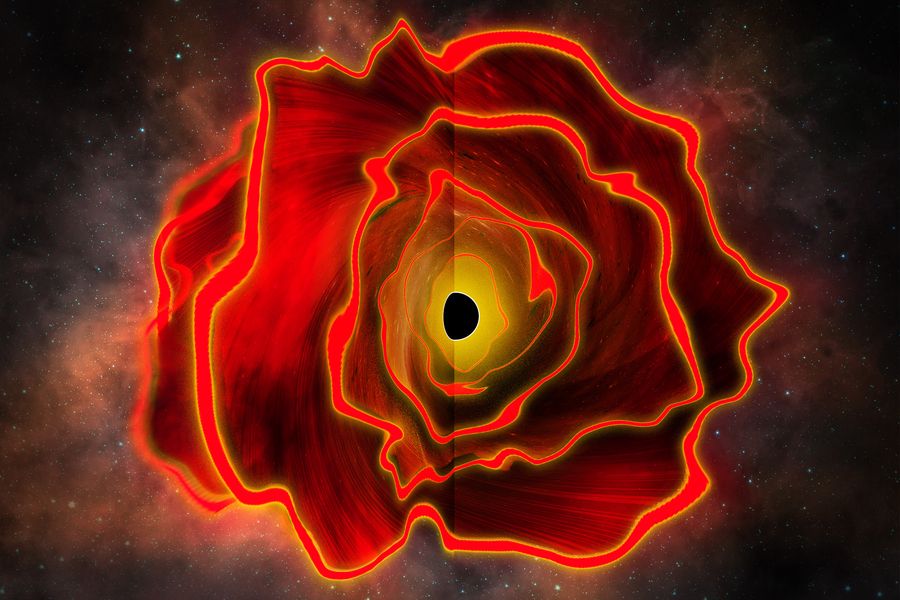
Astronomers have discovered what they describe as a "black hole star" in a paper published in Nature. The object, observed by the James Webb Space Telescope, is the size of our solar system and shines brightly in deep space. The researchers believe it could be a black hole surrounded by a dense and luminous gas. This hypothetical object, named MoM-BH*-1, appears in images from the telescope as one of many reddish spots in the early universe.
MoM-BH*-1 emits about 100 billion times more energy than any star could produce, even during the early universe era in which it formed. The intense light emitted by the object sometimes disappears abruptly, a phenomenon that cannot be explained by normal star behavior. Instead, researchers think an enormous amount of dense gas is absorbing the light, leading them to propose the black hole star hypothesis.
At the center of MoM-BH*-1 lies a black hole devouring matter and releasing enormous amounts of energy, surrounded by a massive gas envelope. This energy passes through the gas before escaping into space, acquiring some of the characteristics we would normally expect from starlight. The discovery of MoM-BH*-1 could help address another mystery uncovered by the James Webb Space Telescope: the presence of small red spots in the early universe whose origins remain uncertain.
These red spots don't fit neatly into the usual categories of objects in deep space and could be compact galaxies teeming with stars, black holes hidden by dust, or systems completely different from those we observe in the present-day universe. However, black hole stars like MoM-BH*-1 are also among these possibilities. Unlike other red spots, MoM-BH*-1's black hole appears to almost completely obscure the surrounding galaxy, making it appear as pure black hole star light.
Written by urgent.news from Wired Science's reporting — not their text. Machine-written — may contain errors; check the original before relying on it.
This story
This is one outlet's version. Read the fullest account.