Black hole star: Astronomers discover a brand-new type of astrophysical object
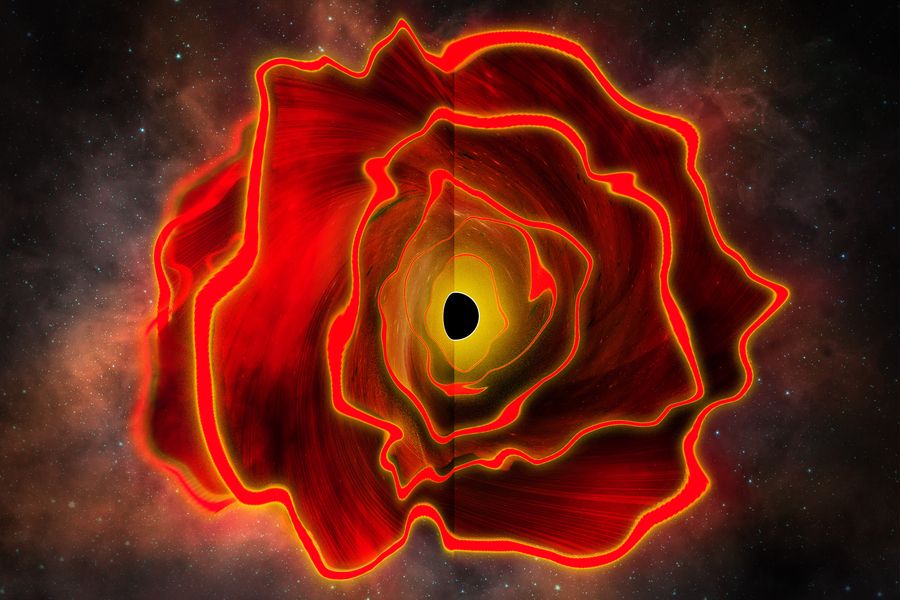
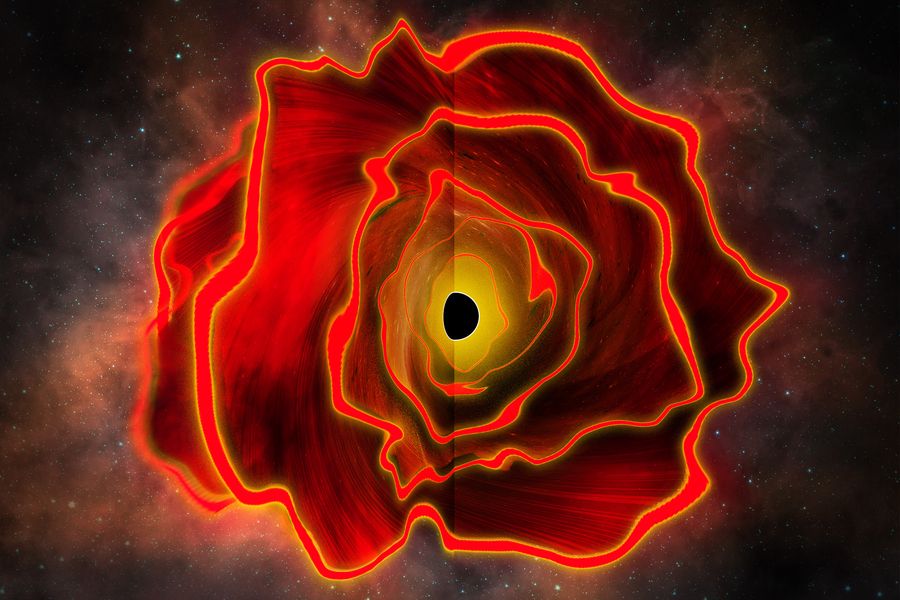
Astronomers at MIT and elsewhere have spotted an extremely bright red spot in the early universe. The object resembles an enormous star, roughly the size of our solar system. But it also is putting out 100 billion times more energy than any known star can physically produce. In fact, such energies are closer to what a black hole might generate.

In a groundbreaking discovery, astronomers at MIT and other institutions have observed a unique celestial object in the early universe, which they are calling a "black hole star." The object, captured by NASA's James Webb Space Telescope, is a red, extremely bright spot resembling an enormous star, similar in size to our solar system. However, it emits an astounding 100 billion times more energy than any known star could produce, hinting at a much more powerful origin.
The researchers suggest that the red spot may be the result of a merger between a black hole and a star, a combination never seen before. The object is believed to be composed of a dense cloud of gas, powered by the energy of a central black hole, rather than standard nuclear fusion. This black hole is estimated to be about 100,000 times more massive than our Sun.
If the bright red dot turns out to be a black hole star, it could provide valuable insights into the identity of other mysterious "little red dots" that have appeared in deep-space images taken by the JWST. These enigmatic objects have puzzled scientists, as they are prevalent in the early universe but seem to disappear by the present day.
The discovery was an unintended byproduct of a survey called Mirage or Miracle (MoM), aimed at finding the earliest galaxies in the universe. While searching for these galaxies, the team stumbled upon a strikingly red and bright dot that stood out from the rest. The dot's red color often indicates the presence of dust, but the team noticed that the light was still extremely bright even below certain wavelengths, where dust would typically absorb it.
The light spectrum of the red dot also revealed a "Balmer break," a signature typically associated with dense gas surrounding young stars. However, the break observed in this object was unprecedentedly deep, ruling out ordinary stars as its source. The team then ran simulations to determine if the red dot could be created by a black hole star.
Their simulations suggested that the object could be an extremely dense cocoon of hydrogen surrounding an active, accreting black hole. This scenario explains the object's extreme brightness and the absence of heavy elements, while also accounting for the light-blocking Balmer break.
The MIT co-authors of the study, including Director Robert Simcoe and Bruno B. Rossi Professor of Experimental Physics Wendy Sun, along with their collaborators, are now working to further analyze this intriguing celestial object and its implications for our understanding of the early universe.
Written by urgent.news from Phys.org's reporting — not their text. Machine-written — may contain errors; check the original before relying on it.