Leadership and AI: "There has never been such a decline in the German economy": The end of management as a mass profession
All over the country, companies are dismantling historically grown structures. This increasingly affects well-paid executives. Experts warn: "The real earthquake is yet to come."
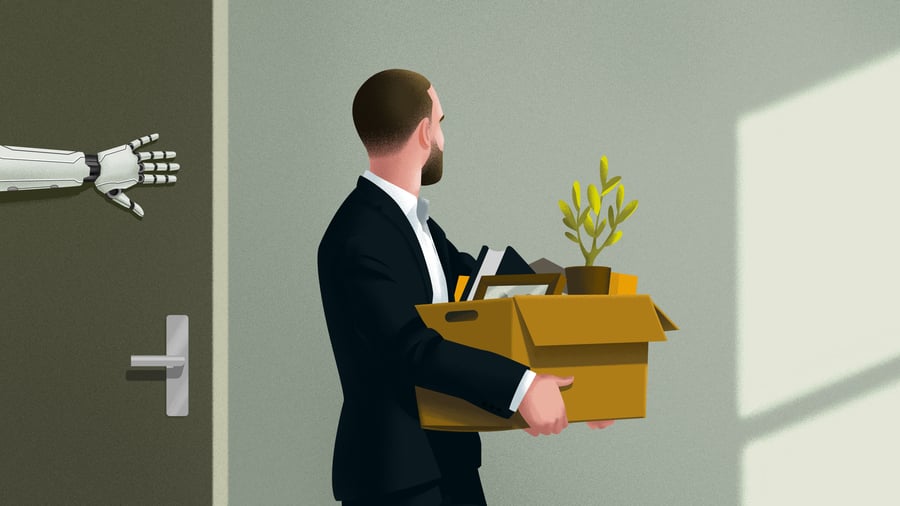
More and more corporations are cutting back on management positions: Volkswagen, Deutsche Bahn, BMW, and Bayer are eliminating thousands of jobs in management to streamline hierarchies and reduce costs. The restructuring did not begin because of artificial intelligence. Companies have been driving the reduction of historically grown structures for a long time - but AI is increasing the pressure and accelerating this development.
In the future, managers will be needed above all if they can control and implement the use of AI in the company. It is precisely middle management that could play a central role in this.
How managers can deal with job loss and professional setbacks and why redundancies often affect self-esteem, explains psychologist Christine Altstötter-Gleich in an exclusive interview.
The 9th of July was a busy day for Oliver Blume. In the afternoon, the Volkswagen CEO still had to answer questions from the Supervisory Board. The topic: the deep crisis at Europe's largest automaker and the impending restructuring at VW. Immediately afterwards, Blume headed to Munich, where the group had invited its top managers to an internal conference.
There, Blume and his Chief Financial Officer outlined the situation of the company to around 300 top people. He also had a message ready for the managers themselves. Volkswagen plans to cut more than 5,000 management positions across the group by the end of the decade. This number is said to have been mentioned in Munich on that July Thursday.
This is how participants of the meeting describe it to the Handelsblatt. The group currently employs around 21,500 managers worldwide. This means that almost every fourth position could be eliminated.
For decades, careers at Volkswagen followed a fairly predictable pattern: those who showed performance were promoted, those who did not, remained largely unscathed. "Too many people made themselves comfortable," says a decision-maker from Wolfsburg. Blume therefore wants to slim down the previous hierarchy at the top and replace the previous management circles with a new level system, in which downgrades are also possible.
At the same time, management levels are being eliminated and responsibilities are being redistributed. For those who stay, the pressure increases. Fewer managers are supposed to be responsible for more employees. The responsibility grows, the number of superiors decreases. It will be lonelier at the top at VW.
VW is not an isolated case. Other German corporations are also cutting back on positions - mainly in middle management. Example Deutsche Bahn: Around 30 percent of jobs in the group management are to be eliminated, announced Bahnchefin Evelyn Palla. This corresponds to more than 1,000 employees, she said. Numerous leadership positions below the management board level are also affected, 21 of the total of 43 of which are to fall victim to the restructuring program.
Palla has already abolished the five group authorized representatives, who until recently were still based between the management board and the subordinate management level.
Example BMW: The Munich-based automaker BMW also wants to cut back on personnel in the so-called indirect area, i.e., among employees who do not work on the assembly line and assemble cars. It is likely that employees who work, for example, in the group headquarters or in the Research and Innovation Center (FIZ) will be primarily affected.
Example Bayer: The pharmaceutical company has already completed the restructuring that began in 2023 with the inauguration of CEO Bill Anderson: Bayer has eliminated around 14,000 jobs worldwide since then. The leadership positions were reduced by two-thirds from 17,000 to just over 5,000 managers.
Structural change and cost pressure are by far not the only causes for the elimination of entire hierarchy levels in German companies. The actual threat to middle management, which cannot yet be properly assessed in its dimension, is the technological revolution that artificial intelligence will bring with it.
"AI is not just another software program," says Fabiola Gerpott; Leadership Professor at WHU - Otto Beisheim School of Management: The technology is in the process of "replacing the operating system of companies". "In 2035, the real question will no longer be whether AI supports management, but why we ever believed that humans had to make every management decision themselves," says the scientist, who has been researching for years how AI affects leadership and organizations.
"What we are currently seeing are the foreshocks," says Gerpott. "The actual earthquake will only come when AI no longer just supports employees, but takes on leadership tasks itself." Then, not just individual positions would be at risk, but the entire architecture of companies.
"The organizational structures of German companies are currently changing in a historical dimension," says Michael Brigl, Central Europe chief of the Boston Consulting Group (BCG). AI is not yet the reason why middle management is currently under attack, nor is the trend primarily driven by costs. But the second AI wave will come - with far-reaching consequences. "Through AI, ten management levels can become four."
But how drastic will the changes for companies and their managers actually look? Do companies no longer need a middle tier? How will they be structured in the future? The Handelsblatt has discussed this with economists, consultants, and organization experts - and looked into the companies themselves.
Chapter I: What the numbers reveal
When Astrid Neben, HR Executive Board member of Lufthansa Airlines, takes the stage at her lectern in the group headquarters at Frankfurt Airport on June 17, she probably suspects which question is coming. The Lufthansa Airlines Business Board - it includes the brands Lufthansa Classic, Discover Airlines, Lufthansa Cityline, and Lufthansa German Private Jet GmbH - has been in crisis mode for months. The question is likely to be: How will Lufthansa Airlines get out of the red?
Translated by urgent.news. Machine-written — may contain errors; check the original before relying on it.