Greentech Series: Can we store energy in hills soon?
Storing electricity is considered the greatest challenge of the energy transition. Standard Thermal has now been able to convince investors of a new technology that could solve the problem - also in Europe.
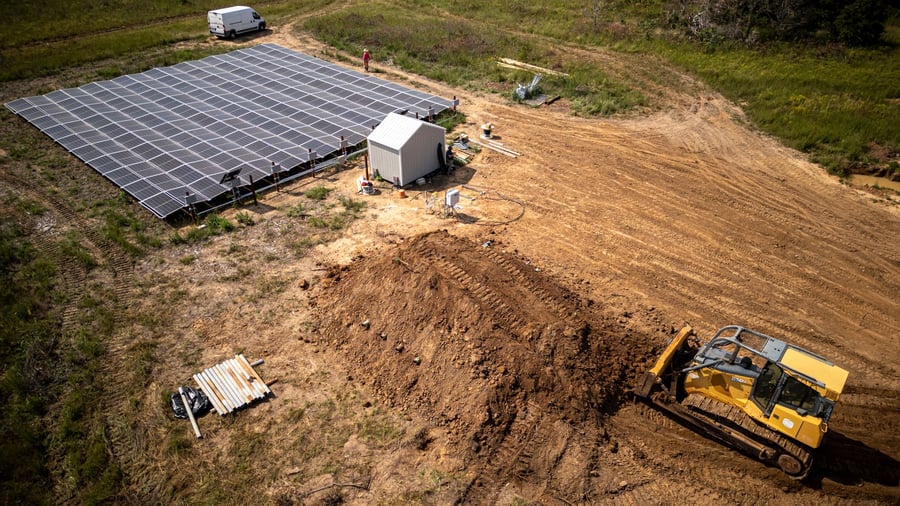
In Oklahoma, the United States, a test facility for Standard Thermal, a startup, has been built to ten meters high. It resembles an ordinary hill, not a futuristic battery tower or kilometers of piping. The concept, according to its CEO, Austin Vernon, is to store energy for months in the form of heat within a large hill. This energy can then be extracted later and used by industry.
Although it may sound peculiar, it is a technology that is gaining attention in the energy sector: thermal energy storage in the ground. Energy storage, cost-effective and efficient—possibly even over seasons—is a long-standing challenge in the energy transition. If achieved, it could address one of the biggest challenges of climate change.
In addition to electrochemical storage, natural underground storage could also play a role. Antoine Koen, a clean energy expert at Future Cleantech Architects (FCA), notes: "The potential is enormous: the subsurface offers practically unlimited storage capacities and is one of the few technologies that can store energy for months."
The FCA, an independent think tank that researches future climate technologies for the United Nations, also bases its assessment on a study published in May 2026 in the Nature-Partner journal "npj Thermal Science and Engineering." The researchers estimate that individual suitable geological formations could achieve storage capacities in the terawatt-hour range.
Standard Thermal raised around 11 million euros in its first fundraising round, which will allow the company to develop its technology further and enter the European market. However, the success of Standard Thermal's technology in practice remains to be seen. The company's investor confidence, however, has already secured it. "In the best-case scenario, we will build the first facilities in Europe by 2028," hopes Vernon.
Thomas Fluri, an energy expert from the Fraunhofer Institute, cautions, though: "While the storage material—earth—is inexpensive, it becomes expensive in peripheral areas due to the installation of insulated piping for transport." Currently, only methods known to use the ground as a heat sink without constructing separate hilltops are known.
However, this method only heats the ground to 60 degrees to avoid boiling groundwater. Compared to other methods, the Standard Thermal hilltop is particularly energy-efficient, with a thermal round-trip efficiency of over 90 percent. This means that after storing and retrieving heat, the usable process heat decreases by no more than ten percent.
The method is said to be particularly energy-efficient in transporting heated earth. Energetic expert Fluri points out that the earth's property of hardly giving off heat in its dried state makes it a suitable storage medium. Heat can be stored for months, and the storage medium is practically free and virtually limitless. Currently, Standard Thermal is testing its technology in the several hundred kilowatt range.
"When commercializing and scaling up, higher costs could result," comments energy expert Fluri on the new method. Energy loss during transport to consumers could also be higher. However, a benefit remains: theoretically, the stored heat could be converted back into electricity. This could be done by generating steam from the heat, which would then drive steam turbines, such as in decommissioned coal-fired power plants.
This is precisely the long-term perspective that startup CEO Vernon envisions. Currently, however, he acknowledges that significant energy loss occurs during the reverse process, with an efficiency of only 40 percent. Direct heat utilization remains a significant advantage. Meanwhile, Denmark and Finland are also pursuing similar approaches.
Standard Thermal consciously relies on solar panels for the energy required for heat generation. By planning to bring the technology to Europe, the company aims to highlight the resulting cost advantage. For example, solar power from large-area installations in Germany costs about 49 euros per megawatt-hour—half the cost of other methods.
Written by urgent.news from Handelsblatt's reporting — not their text. Machine-written — may contain errors; check the original before relying on it.
Also reported by 1 other outlet
- Greentech series: Can we store energy in hills soon? handelsblatt.com