Equatorial Pacific Warming Pattern Mitigated by Slow Ocean Adjustment
Model simulations under an abrupt 4x CO 2 scenario reveal that initially enhanced gradients in sea surface temperature under global warming are then mitigated by circulation changes.
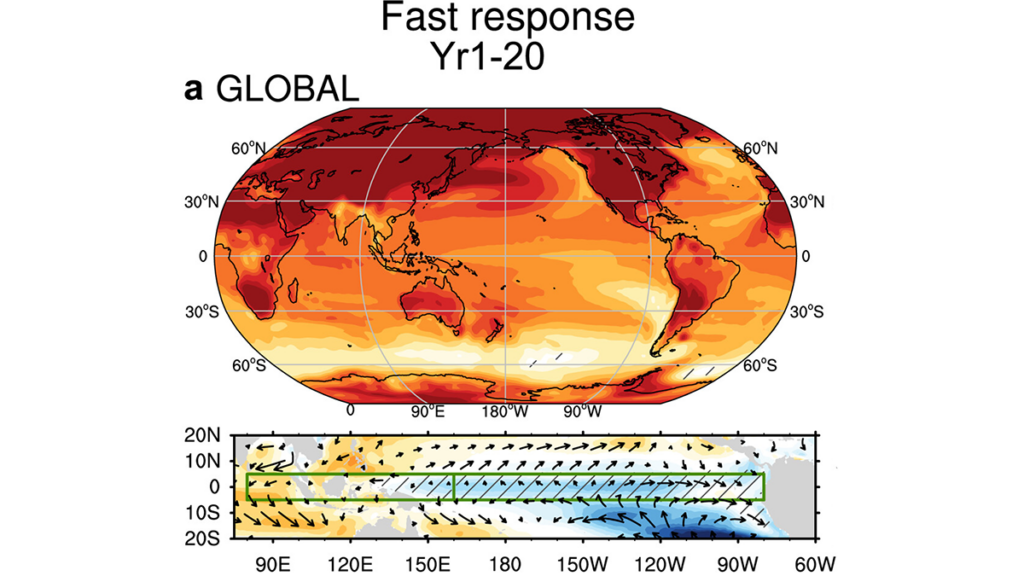
A recent study published in AGU Advances has revealed a two-phase transition in equatorial Pacific warming patterns, driven by both ocean dynamics and remote atmospheric forcing. The research, conducted by Olonscheck and Kang, utilized model simulations under a hypothetical scenario of a four-fold increase in atmospheric CO2 concentrations.
The study showed that the initial response to warming was an intensification of the tropical Pacific sea-surface temperature (SST) gradient, with warmer waters in the western Pacific and cooler waters in the eastern Pacific. This phase was attributed to changes in ocean circulation coupled with remote influences from the Northern Hemisphere.
The authors found that after this initial strengthening, the Pacific SST gradient underwent a long-term weakening trend. The transition to the weakened pattern was driven by slow adjustments in the ocean's thermal structure, highlighting the complex feedback mechanisms at play in response to global warming. These findings have significant implications for climate projections, emphasizing the need for improved models that accurately capture these oceanic feedbacks.
Written by urgent.news from Eos's reporting — not their text. Machine-written — may contain errors; check the original before relying on it.