Nobel physics prize honours work on ‘ghostly messengers’ from outer space
Belgian physicist Francis Halzen on Tuesday won Nobel physics prize for groundbreaking work using South Pole ice to capture cosmic particles.
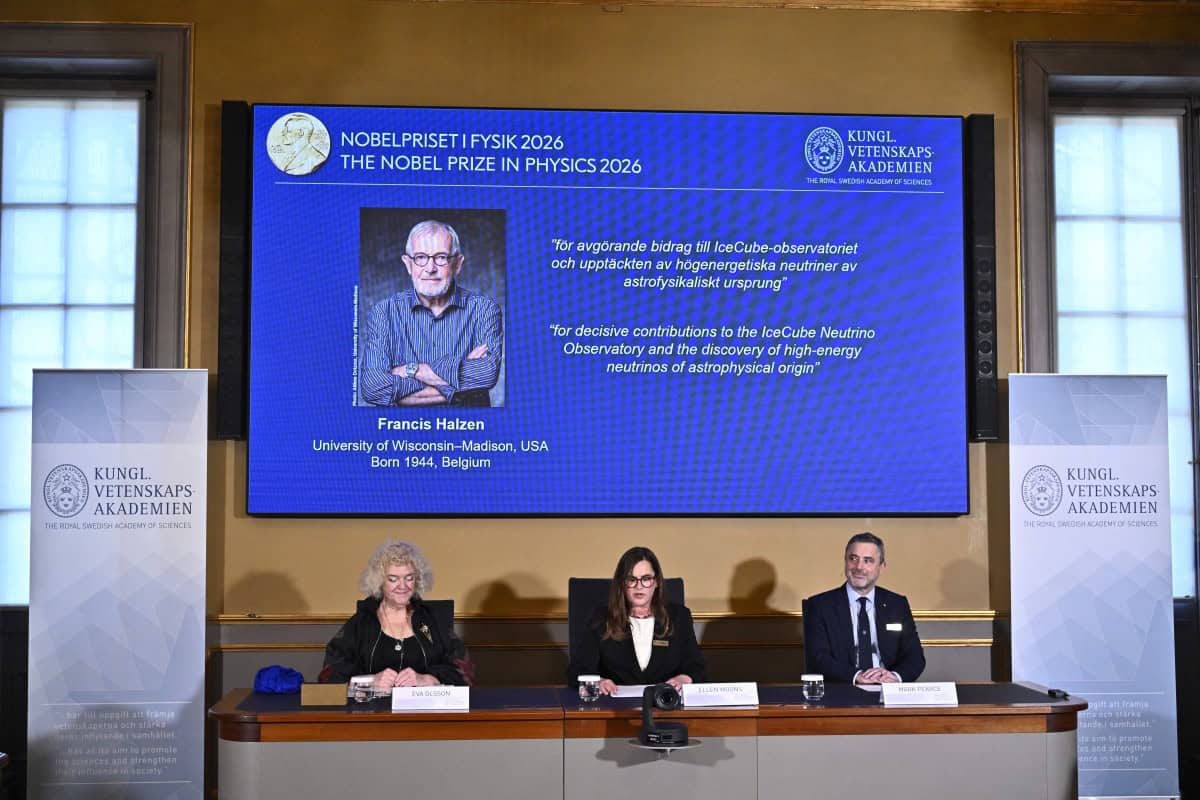
Belgian physicist Francis Halzen secured the Nobel physics prize on Tuesday for his pioneering work utilizing South Pole ice to detect particles from distant cosmic sources, offering unprecedented insights into the vast reaches of space. Ellen Moons, secretary general of the Royal Swedish Academy of Sciences, described the year's honor as focusing on "ghostly messengers from space."
Halzen's groundbreaking contribution was the IceCube Neutrino Observatory, a cubic kilometer of ice equipped with light sensors designed to capture high-energy neutrinos originating from astrophysical events. This pioneering technology has revolutionized the field of "extreme" astronomy, enabling researchers to study neutrinos produced in powerful cosmic processes.
Born in Tienen, Belgium, Halzen, now 82, is a professor at the University of Wisconsin-Madison in the United States, where he holds citizenship. The Nobel jury commended Halzen's vision, which first emerged in 1988, and its subsequent development, which required an immense volume of ice to detect the infrequent high-energy neutrino collisions.
He expressed his surprise at the recognition, stating that it honored the "courageous people" who supported his early vision. Belgium's Prime Minister praised Halzen as the 11th Belgian to win a Nobel Prize, emphasizing his dedication to unraveling the cosmos' most elusive secrets. While speculating about potential extraterrestrial messages, Halzen remained grounded, focusing on the practical challenges.
This is the second Nobel award of the season, following a medicine prize awarded on Monday. The upcoming Nobel prizes will include chemistry, literature, peace, and economics.
Written by urgent.news from The Citizen's reporting — not their text. Machine-written — may contain errors; check the original before relying on it.
This story
This is one outlet's version. Read the fullest account.
- Nobel physics prize goes to the man who turned South Pole ice into a neutrino trap malaymail.com
- Nobel physics prize honours work on 'ghostly messengers' from outer space thelocal.se
- Nobel physics prize honours work on ‘ghostly messengers’ from outer space torontosun.com
- What the 2026 Physics Nobel winner has done: Capturing messengers from space in ice indianexpress.com