Little Red Dots Are The Seeds of Quasars and Supermassive Black Holes
Computer simulations find that overmassive black holes form readily in the early universe. Their spectra match that of Little Red Dots, which later become powerful quasars and supermassive galactic black holes.
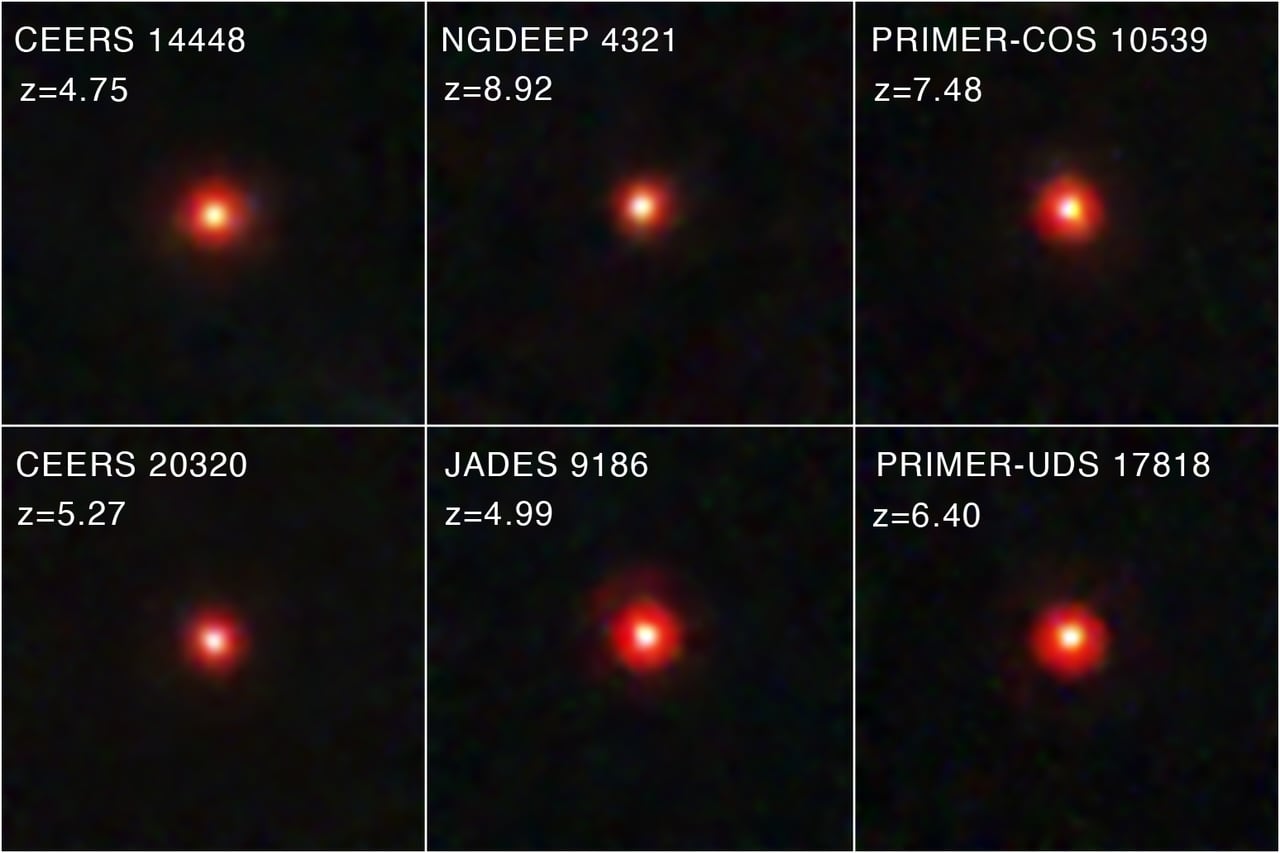
When the James Webb Space Telescope (JWST) peered into the darkest parts of the early Universe, it discovered a new phenomenon: Little Red Dots (LRDs). These faint, red, point-like objects were seen a mere billion years after the Big Bang. Astronomers were perplexed by these objects, wondering if they were young, powerful active black holes or enormous progenitor stars.
LRDs emitted little radio or X-ray light, unlike quasars, and had a spectrum akin to the first stars, yet also showed a strong rotational Doppler shift. A new study in Nature claims that LRDs are in fact young, overmassive black holes. Using computer simulations of the early cosmos, researchers modeled a proto-galaxy and observed the effects on its evolution.
They discovered that gas clouds within the proto-galaxy, bathed in bright ultraviolet light, could not form into stellar nurseries. Instead of fragmenting into smaller clouds, these massive gas clouds collapsed directly into a supermassive star, which then rapidly transformed into a black hole. These black holes initially had a mass equivalent to about a million Suns.
The early Universe's radiative environment aided the black hole's growth by pushing gas towards it at a super-Eddington rate, allowing it to consume matter more rapidly. This growth pattern explains why LRDs share a similar spectrum with both black holes and primordial stars. Moreover, this theory could also account for the early appearance of supermassive black holes in the Universe.
LRDs seem to be the seeds of galactic black holes and quasars, evolving from gas clouds directly into black holes in a matter of millions of years.
Written by urgent.news from Universe Today's reporting — not their text. Machine-written — may contain errors; check the original before relying on it.
This story
This is one outlet's version. Read the fullest account.