Black Holes or Black Hole Stars? Astronomers Spar Over Webb Telescope’s ‘Little Red Dots.’
The James Webb Space Telescope spots mysterious “little red dots” everywhere. A bold new theory suggests they’re suns dozens of times larger than our entire solar system. The post Black Holes or Black Hole Stars? Astronomers Spar Over Webb Telescope’s ‘Little Red Dots.’ first appeared on Quanta Magazine
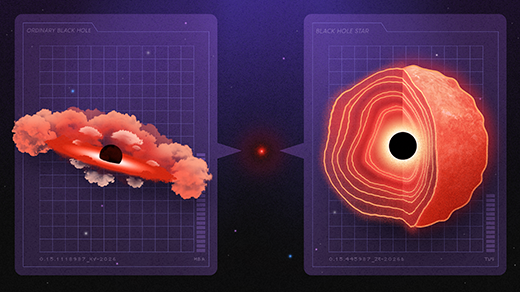
The James Webb Space Telescope was designed to capture faint light from the Big Bang's aftermath, an era filled with hydrogen and helium gas forming galaxies. Capturing these images, astronomers encountered a bewildering assortment of light smears. One group of objects particularly baffled researchers. They were intense, glowing red light with long wavelengths, yet they were diminutive, just a pixel in size, and ubiquitous, appearing in most Webb images. Astronomers coined these objects "little red dots."
Initially, researchers considered the dots as galaxies. However, they soon realized that little red dots resembled supermassive black holes, the densest objects at the hearts of galaxies. These black holes, though invisible, devour surrounding gas and matter, creating swirling rings of hot, luminous material that outshine the stars in their vicinity. In 2025, two research groups independently announced observations of two little red dots that differed drastically from the others, even from the observable universe.
One group of astronomers, led by Anna de Graaff from the Max Planck Institute for Astronomy, proposed that these peculiar objects are black hole stars. This theory suggests that these are lumps of hydrogen emitting the light of billions of suns while concealing a black hole at its core. While this idea raises fascinating possibilities, it remains a subject of debate. Some scientists argue that Webb might be witnessing the birth of supermassive black holes inside colossal stars.
However, not everyone subscribes to this interpretation. The lack of observable characteristics like flickering or X-ray emissions from the little red dots makes some astronomers skeptical. This controversy has fueled further research and intensified the debate about the nature of these enigmatic objects. As the story unfolds, the field has become polarized, with astronomers grappling with the challenge of interpreting these specks of light, given their color and brightness.
Written by urgent.news from Quanta Magazine's reporting — not their text. Machine-written — may contain errors; check the original before relying on it.