Where Does the Quantum World End and Ours Begin?
Jonathan Halliwell explains how quantum decoherence is key to understanding how we transition from a world with a wave-like nature of matter and energy to the classical macroscopic world that we’re used to. The post Where Does the Quantum World End and Ours Begin? first appeared on Quanta Magazine
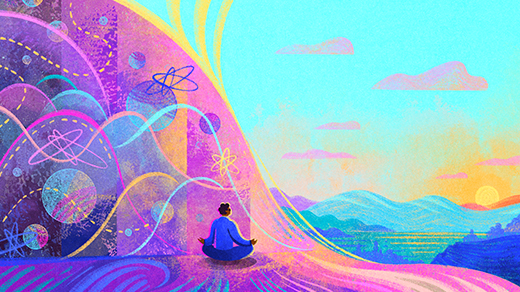
Jonathan Halliwell, a professor of theoretical physics at Imperial College London, has dedicated his career to probing the foundations of quantum theory. He spoke with Steven Strogatz about his work, the crucial role of decoherence in the transition from quantum to classical behavior, and the "histories" approach he uses to understand this phenomenon.
Along the way, Halliwell addressed some of the field's deepest paradoxes, including the quantum-to-classical transition not requiring a conscious observer and Einstein's famous question about the moon's existence when no one looks.
Halliwell's journey to quantum foundations began in quantum cosmology, where he sought to apply quantum mechanics to the entire universe. This focus stemmed from questions about the Big Bang model, which combines quantum matter with classical gravity, leading to a singularity at the universe's beginning. Seeking a quantum theory of gravity to fill this gap, Halliwell explored a few elements of the gravitational field, such as the overall size and scale factor, and quantized these models, providing a non-singular beginning to the universe.
Written by urgent.news from Quanta Magazine's reporting — not their text. Machine-written — may contain errors; check the original before relying on it.