NASA launches Nancy Grace Roman Space Telescope to shed light on the dark universe
The observatory will also study exoplanets, black holes and map billions of galaxies The post NASA launches Nancy Grace Roman Space Telescope to shed light on the dark universe appeared first on Physics World .
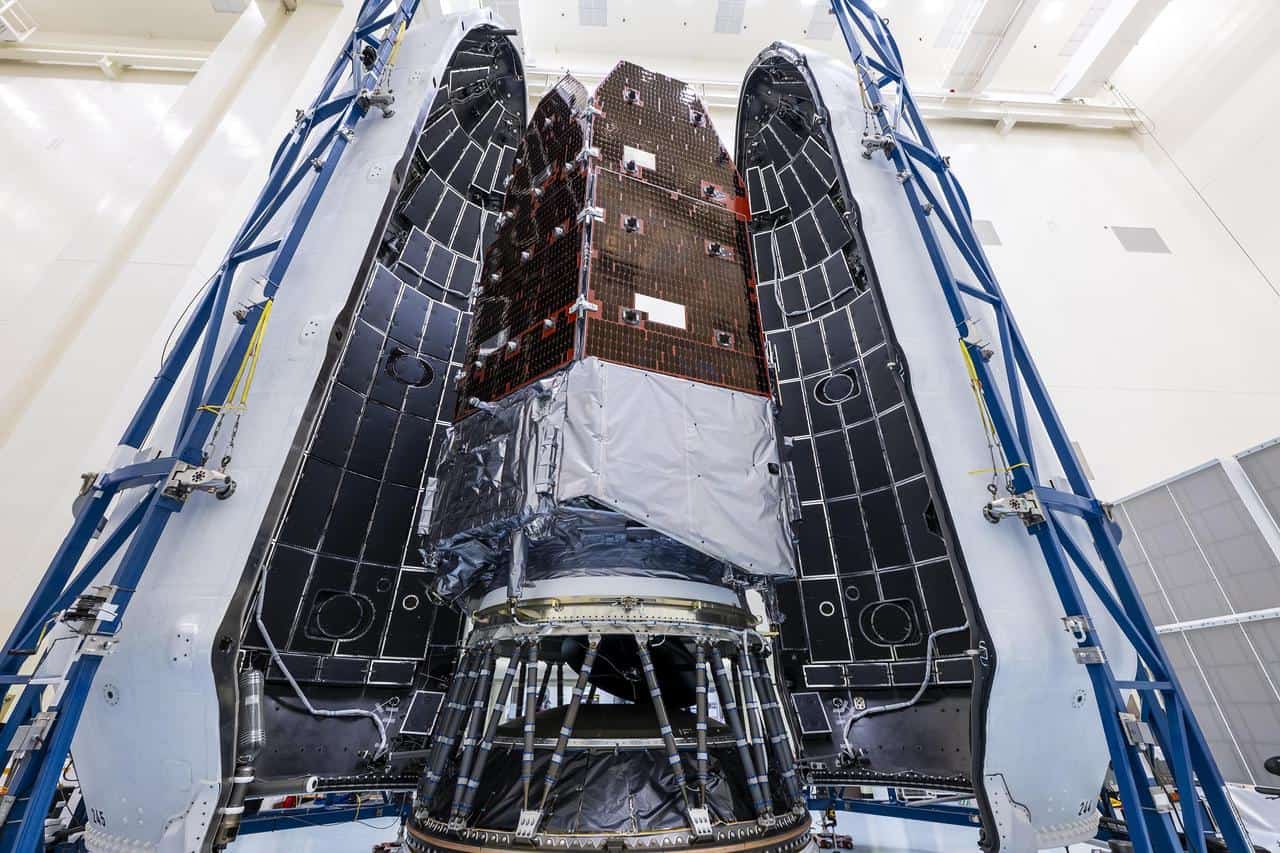
NASA has launched the $4.3bn Nancy Grace Roman Space Telescope aboard a SpaceX Falcon Heavy rocket from Kennedy Space Center in Florida on 30 August at 7:26 am local time. The telescope will spend three months traveling to the second Sun-Earth Lagrange point (L 2), located about 1.6 million kilometers from Earth. Once at L 2, the telescope will conduct a wide survey of space, with a field of view 100 times larger than that of the Hubble Space Telescope.
From its vantage point, the Nancy Grace Roman Space Telescope will help astronomers understand dark energy and dark matter, discover and characterize exoplanets, map billions of galaxies, and gain new insights into black holes. The observatory features a 2.4-meter primary mirror and two instruments: a wide-field instrument for high-resolution images in visible and near-infrared light, and an experimental coronagraph to detect exoplanets by canceling out starlight.
NASA's associate director, Nicola Fox, described Roman as a "discovery machine" that brings humanity closer to answering profound questions about the universe's history. The telescope is expected to operate for at least a decade, with three planned surveys for its initial five years. The first will locate tens of thousands of distant supernovae, the second will observe over a billion galaxies, and the third will search for exoplanets using gravitational microlensing techniques through the Milky Way's center.
Although initially known as the Wide-Field Infrared Survey Telescope, the Roman Space Telescope underwent design changes due to budget constraints before being renamed in honor of Nancy Grace Roman, NASA's first chief astronomer in the 1960s. The telescope will complement the Hubble and James Webb Space Telescopes, providing comprehensive data on the universe to be studied by these instruments using advanced technologies like machine learning, artificial intelligence, and citizen science.
NASA administrator Jared Isaacman hailed the mission as a success story completed ahead of schedule and on budget, showcasing the potential of America's space program when it combines bold ambition with disciplined execution.
Written by urgent.news from Physics World's reporting — not their text. Machine-written — may contain errors; check the original before relying on it.
This story
This is one outlet's version. Read the fullest account.
- How NASA's new space telescope could help solve mysteries of dark energy and dark matter pbs.org
- 'No guts, no glory': How I captured NASA's Roman Space Telescope cross the sun on a picture-perfect SpaceX Falcon Heavy launch space.com
- WATCH: NASA launches revolutionary new telescope abcnews.com
- Where is the Roman Telescope in space? scientificamerican.com
- Track NASAs Roman Space Telescope on its long cruise to deep space mashable.com
- Nasa launches ‘Mother of Hubble’-named telescope to map the cosmos malaymail.com
- Dark energy, exoplanets and black holes: What Nasa’s new Roman telescope will explore timesofindia.indiatimes.com