Collapsed glacier likely caused devastating Nepal-Tibet floods, scientists say
Preliminary investigations by scientists have pointed to a collapsed glacier as the cause, highlighting the issue of rapidly melting Himalayan ice.
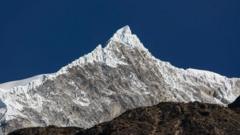
Scientists have concluded that a collapsed glacier is responsible for the devastating floods that struck the Nepal-Tibet border, underscoring the growing threat of rapidly melting Himalayan ice. Initially, an earthquake was suspected to have triggered the landslide, but the US Geological Survey later clarified that it was caused by the collapse of a glacier.
The impact of the glacier's disintegration sent a wave of debris downstream, causing a sudden surge in a river, which led to the flooding that killed at least 469 people.
Dr. Simon Cook, a glacier expert from the University of Dundee, reported that the lower part of a glacier near the Langtang Lirung peak in Nepal collapsed, traveling in a northwesterly direction and subsequently westwards. An analysis by the International Centre for Integrated Mountain Development found that a large volume of ice and rock debris entered the Lende Khola, a tributary of the Bhote Koshi river, resulting in a rapid rise in water levels in nearby rivers. The floods devastated several water monitoring stations.
Professor Mike Searle of Oxford University explained that the process of a landslide causing a flood could take several hours or days. The steep valleys surrounding Langtang Lirung, a high mountain in the Himalayas, may have further exacerbated the disaster. The glacier, like others in the Himalayas, was rising due to tectonic plate movement, making it more prone to collapse. However, this particular collapse was unprecedented, likely the result of both tectonic uplift and climate change-induced warming.
In recent years, scientists have warned about the accelerating melting of glaciers in the Himalayas due to climate change, which has doubled the rate of ice loss since 2000. This trend has heightened the risks of flooding and landslides. The 2021 Chamoli glacier collapse in northern India, which killed 200 people, serves as an example of the catastrophic consequences of such events.
Experts now expect similar disasters to become more frequent, driven by the destabilizing effects of a warming planet on high mountain environments.
Written by urgent.news from BBC World's reporting — not their text. Machine-written — may contain errors; check the original before relying on it.
This story
This is one outlet's version. Read the fullest account.
- Collapsed glacier likely caused deadly Nepal-Tibet floods, scientists say myjoyonline.com
- How a glacier collapse is believed to have caused Nepal-Tibet disaster france24.com
- Collapsed glacier likely caused devastating Nepal-Tibet floods, scientists say gbcghanaonline.com
- How a glacier collapse may have caused Nepal-Tibet disaster iol.co.za
- How a glacier collapse may have triggered the Nepal-Tibet disaster euronews.com
- How a glacier collapse may have caused Nepal-Tibet floods rte.ie
- Watch: How the collapse of a glacier caused such devastation bbc.co.uk