How a glacier collapse may have caused Nepal-Tibet disaster
A huge piece of ice that fell thousands of metres from a glacier into a river below may have unleashed the disaster in Nepal and Tibet that killed at least 180 people.
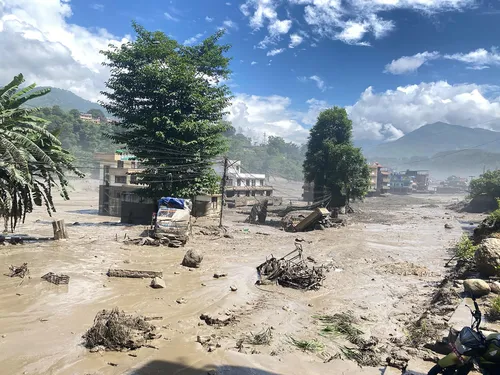
A massive chunk of ice dislodged from a high-altitude glacier and plummeted thousands of meters into a river below, triggering a catastrophic disaster in Nepal and Tibet that claimed over 180 lives. The glacier, situated near the border of Tibet, shed a sizable piece of ice about 5,200 meters above the valley floor. Simon Cox, a principal scientist at GNS Science from New Zealand, explained that this colossal chunk of ice transformed into a torrent of debris, rocks, and trees as it cascaded down the canyon.
The initial impact of this monstrous wave of water devastated a border post, as captured by chilling CCTV footage showing the area engulfed in mud and debris as people desperately fled. The debris flow then travelled downstream into Nepal, flooding communities, collapsing structures, and ravaging bridges.
The seismic event, initially misinterpreted as an earthquake, was later identified as a glacial collapse by the US Geological Survey. The magnitude of the seismic activity registered at 5.2 on the Richter scale, occurring at 8:37 am local time. Estimating the exact volume of the glacier that collapsed is still under investigation, but it could range from half a million cubic meters to tens of millions of cubic meters.
Given the remote and inaccessible nature of the affected area, experts are relying on satellite imagery and ground measurements to piece together the disaster.
Water monitoring stations in the vicinity stopped transmitting following the seismic activity, while downstream stations began going offline one by one. Early reports suggested a glacial lake outburst flood (GLOF), a dangerous phenomenon that occurs when a barrier of debris holding back a lake of melted glacier water suddenly gives way, unleashing a torrent of water.
However, experts have ruled out the possibility of a pre-existing glacial lake near the site of the collapse. It is believed that water accumulated beneath the glacier might have cascaded down with the falling chunk of ice, or the collapsing ice may have briefly dammed the river, collecting water behind it, which was then released when the ice dislodged.
Summer glacier melt and monsoon rains had already raised river levels, and the volume of water was further swelled by debris and mud carried downstream. Cox emphasized that the combination of mud and water moving at high speeds was akin to liquid concrete, emphasizing the need for people in affected communities to immediately seek refuge on higher ground.
While it is difficult to directly link individual glacial events to climate change, the warming planet poses a constant stress on ancient ice rivers, increasing the risk of disasters. Glaciers are receding globally, causing environmental disruptions and depriving downstream communities of essential water resources. Reducing greenhouse gas emissions to curb global warming is the most effective way to mitigate such risks.
Written by urgent.news from IOL's reporting — not their text. Machine-written — may contain errors; check the original before relying on it.
This story
This is one outlet's version. Read the fullest account.
- Collapsed glacier likely caused deadly Nepal-Tibet floods, scientists say myjoyonline.com
- How a glacier collapse is believed to have caused Nepal-Tibet disaster france24.com
- Collapsed glacier likely caused devastating Nepal-Tibet floods, scientists say gbcghanaonline.com
- How a glacier collapse may have triggered the Nepal-Tibet disaster euronews.com
- How a glacier collapse may have caused Nepal-Tibet floods rte.ie
- Watch: How the collapse of a glacier caused such devastation bbc.co.uk