El Niño is disrupting the Pacific’s marine food web from the bottom up
As the 2026 El Niño strengthens in the equatorial Pacific, satellites are capturing the first major signs of disruption to the marine food web. According to by NASA’s Earth Observatory observations, satellite measurements show a substantial drop in surface concentrations of chlorophyll across the Central Pacific compared with neutral conditions in June 2025. Chlorophyll is […]
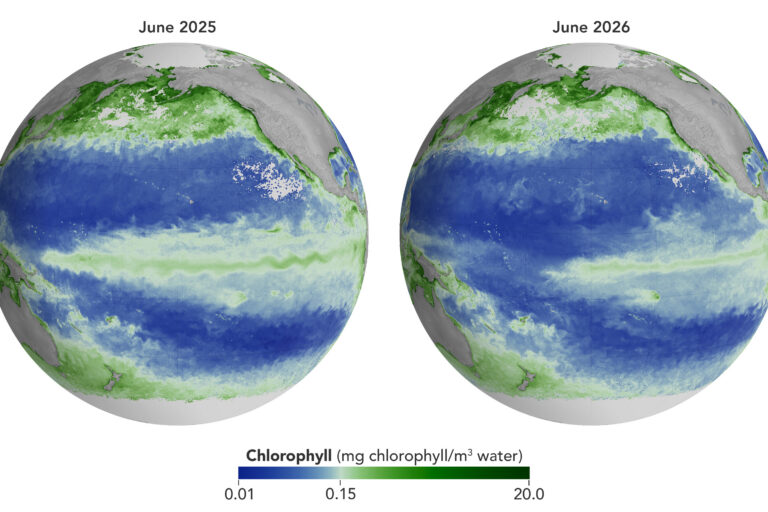
As the 2026 El Niño intensifies in the equatorial Pacific, scientists are observing the first significant disruptions to the marine food web, according to NASA’s Earth Observatory. Satellite measurements indicate a notable decline in surface chlorophyll concentrations across the Central Pacific compared to neutral conditions in June 2025.
Chlorophyll, a pigment vital for photosynthesis in plants, is a key indicator of phytoplankton abundance - the foundation of the ocean’s food chain. Hyung-Gyu Lim, a Chonnam National University oceanography professor, explained to Mongabay that El Niño can slow down the upwelling process, where nutrient-rich cold waters rise from the depths to the surface.
This nutrient scarcity is not unexpected, he stated. Matthew Kehrli and Graham Trolley, oceanographers at NASA’s Goddard Space Flight Center, noted in a NASA Earth Observatory article that weakening easterly trade winds during El Niño allows warm surface waters to extend deeper, suppressing upwelling. As El Niño progresses, chlorophyll levels are expected to plummet further across a wider area.
The ecological ramifications of this nutrient shortage would translate to diminished food sources for zooplankton, fish, seabirds, and marine mammals, as highlighted by the NASA Earth Observatory. This has far-reaching implications for fisheries, as Peru's anchovy fisheries have experienced substantial catch reductions during past El Niño events, caused by warmer surface waters, reduced upwelling, and lower...
Written by urgent.news from Mongabay's reporting — not their text. Machine-written — may contain errors; check the original before relying on it.