In 1984, NASA sent 3,301 bees to space to see how they built honeycomb
Thousands of honeybees traveled into space aboard NASA's Space Shuttle Discovery in 1984. These bees were sent to microgravity to see if they could survive and build their famous honeycomb. Initially, some bees crashed into walls, but they adapted within days. By the mission's end, the bees flew normally and built about 200 cm of honeycomb. Most bees survived, and the queen laid eggs which did…
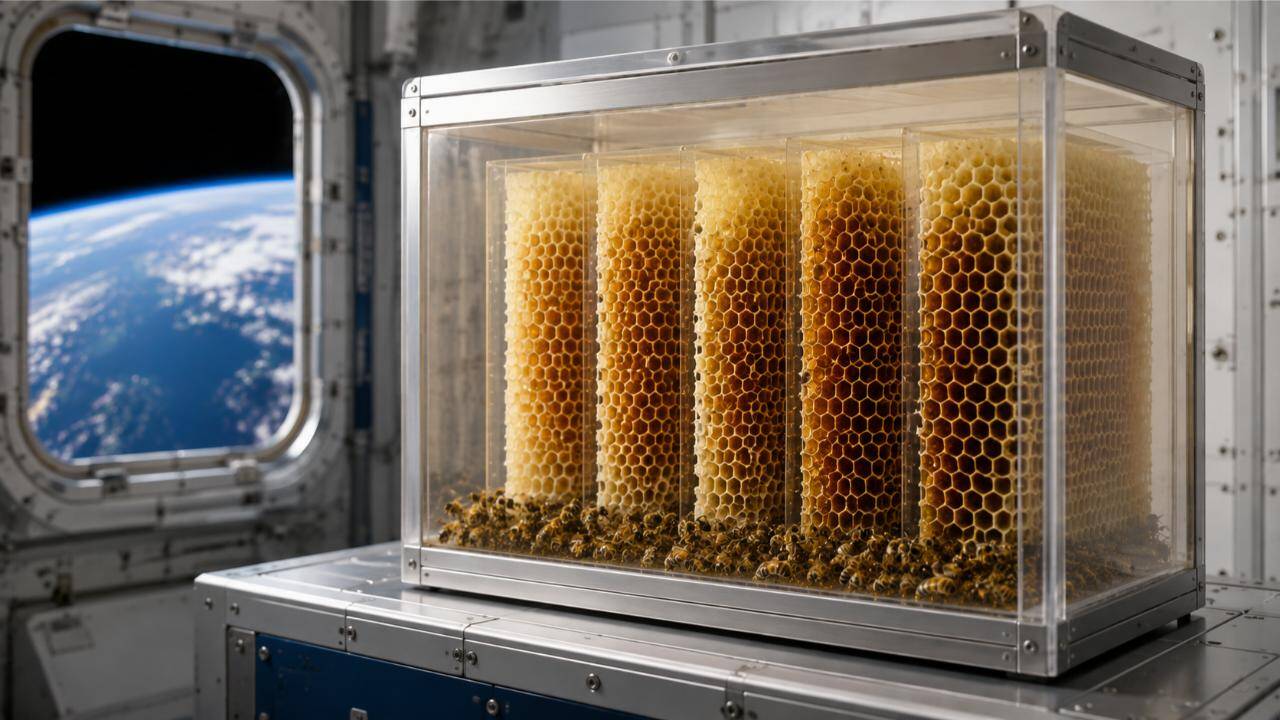
In 1984, NASA launched a unique experiment to understand how honeybees would adapt to life in microgravity. Three thousand three hundred and one bees were sent aboard the Space Shuttle Discovery for a seven-day mission. The goal was to observe whether the bees could survive and build their characteristic honeycomb without the influence of Earth's gravity.
The bees were housed in specially designed enclosures, which included a queen bee, food, and wooden frames. They were kept in a Bee Enclosure Module, a small and specially designed module measuring 45.7 by 12.1 by 48.3 centimeters. This module was later donated to the Smithsonian's Steven F. Udvar-Hazy Center in Virginia.
Initially, the bees struggled with the new environment, colliding with the walls of their enclosure as they attempted to fly. However, by the end of the mission, they had adapted to microgravity and were flying normally. The bees built approximately 200 centimeters of honeycomb during the experiment. Researchers found that the honeycomb cells had smaller average diameters and thicker walls compared to those built on Earth.
Despite these differences, the bees were still able to construct cells of normal depth and use them to store sugar syrup.
The experiment also revealed that the mortality rate among the bees was lower than expected. Notably, the bees flew faster in weightlessness than they did on Earth. The findings suggested that bees could rely on behavioral adaptation to coordinate their activities, even in the absence of familiar environmental cues like gravity.
Written by urgent.news from Times of India's reporting — not their text. Machine-written — may contain errors; check the original before relying on it.