The CosmoQuest Satellite Will Listen to the Early Universe From the Far Side of the Moon
A tiny UK-developed satellite, roughly the size of a small carry-on suitcase, could help answer one of the biggest questions in cosmology: what happened in the roughly 150 million years of cosmic dark ages, before the universe’s first stars appeared?
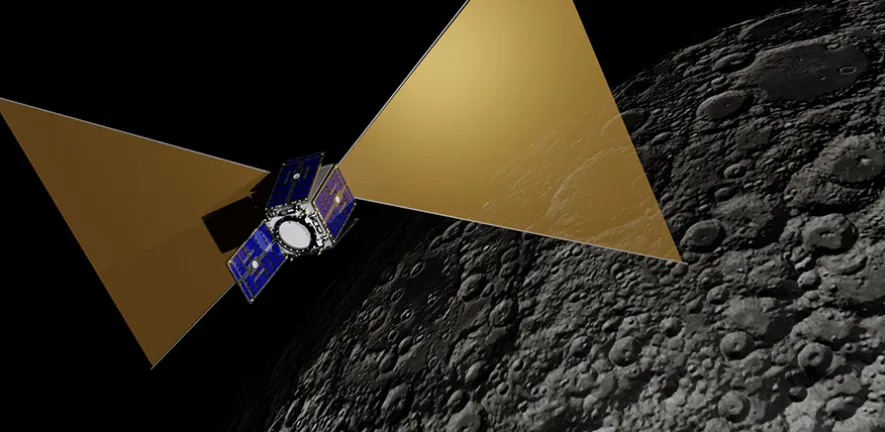
The CosmoQuest satellite, currently in development at the University of Cambridge, is set to embark on a groundbreaking mission to the far side of the Moon. This novel endeavor aims to unravel the mysteries of the early Universe, a period shrouded in mystery known as the Cosmic Dark Ages. During this epoch, which spanned from approximately 380,000 years to 1 billion years after the Big Bang, the Universe was a mere whisper of light, composed primarily of neutral hydrogen.
The far side of the Moon, an ideal radio-quiet location free from terrestrial interference, presents an unprecedented opportunity for radio astronomy research. This unique setting safeguards the satellite from radio-frequency interference (RFI) and offers an unparalleled vantage point to study the faint whispers (21-centimeter line) emitted by hydrogen atoms during the Cosmic Dark Ages.
These signals, undetected by Earth-based telescopes due to atmospheric interference and radio-frequency pollution, hold the key to understanding the formation of the first galaxies and the role of Dark Matter in cosmic evolution.
With a two-year primary mission, the CosmoCube satellite will conduct 1000 hours of data collection and analysis. Upon its return to Earth, the team will employ sophisticated Bayesian statistical analysis and advanced computer simulations to filter out foreground noise, such as natural radio emissions from the Milky Way, and remove any remaining distortions.
This comprehensive approach will enable the extraction of valuable insights into the early Universe's evolution, shedding light on the transition from darkness to transparency.
However, the path to this scientific breakthrough is fraught with challenges. As multiple space agencies vie for access to the Moon's radio-quiet environment, the satellite's mission could face disruption. Moreover, the harsh conditions of the Moon's far side, including extreme temperature variations and the absence of an atmosphere, necessitate innovative engineering solutions.
Despite these obstacles, the CosmoQuest satellite stands poised to make significant contributions to our understanding of the cosmos, bridging the gap between the enigmatic era of the Dark Ages and the emergence of the first galaxies.
Written by urgent.news from Universe Today's reporting — not their text. Machine-written — may contain errors; check the original before relying on it.