Hunderttausende demonstrieren: Frankreichs Protesttag endet in Gewalt und Plünderungen
150 verletzte Polizisten, 1.200 Festnahmen: Frankreichs Premierminister spricht von einem „entsetzlichen Ausmaß an Gewalt“. Was folgt auf die Ausschreitungen?
Frankreich's nationwide protest day ended in violence and looting, with Prime Minister Sébastien Lecornu condemning "a terrible scale of violence." Over 150 police officers were injured and around 1,200 people were arrested. The protests against high living costs involved hundreds of thousands of people. Many cities witnessed violence, looting, and property damage, causing millions in damages.
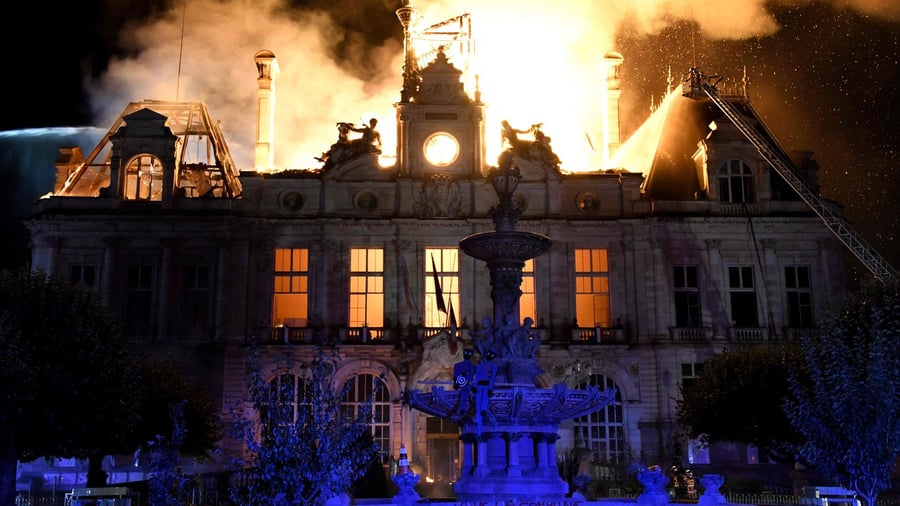
In Limoges, rioters set the historic city hall, protected by heritage status, ablaze. Limoges' mayor, Guillaume Guérin, expressed that there are "no words to condemn the events that took place, so vile they are, the country is in a chaotic state." The mayor, surrounded by deputies weeping, said they destroyed a building dear to Limoges residents but did not destroy public services.
Lecornu stated the police faced "particularly violent ultraright, a very well-organized, clandestine group that methodically tried to attack property, persons, and the institutions of the Republic." He emphasized, "We will not be intimidated." The justice minister, Gérald Darmanin, described "outbreaks of unprecedented extent, which are still ongoing."
He urged all state prosecutors to show a "decisive judicial response commensurate with the violence that has plagued our country." President Emmanuel Macron threatened consequences for those responsible, stating, "In our republic, there is no place for violence." Rioters in Marseille attempted to enter a police station, gained access to the city hall, and looted shops.
In Lyon, the tourist information center was set ablaze and businesses suffered damage. Firefighters were prevented from intervening. In Avignon, rioters entered the prefecture's inner courtyard and in Grenoble, there were property damages to the city hall. Paris' mayor, Emmanuel Grégoire, reported completely destroyed city streets, describing witnessing businesses on the outskirts of residential areas being set ablaze.
Land-wide protests and demonstrations were attended by 550,000 people, with 110,000 in Paris according to Inland Minister Laurent Nuñez. The CGT union reported 800,000 participants. One protester suffered a hand amputation from a police grenade in Saint-Étienne, and three others were injured by flash grenades from the police in Nancy.
The protest, which lacked any clear organizational affiliation, also covered high fuel prices, low wages, the large number of employees paid below the minimum wage, and agricultural and fire service problems. The government's ability to respond to protesters' demands is limited, given France's existing budget deficit and high debt.
Concern was expressed about a resurgence of the Yellow Vest movement. The government fears the demonstrations could fuel broader protests, reminiscent of the Yellow Vest movement in 2019. France will elect a new president next year, with incumbent Emmanuel Macron ineligible. Current polls show far-right candidate Marine Le Pen leading with around 34 percent in the first round, though left-wing candidate Jean-Luc Mélenchon surged, overtaking centrist Édouard Philippe in some surveys.
Written by urgent.news from Handelsblatt's reporting — not their text. Machine-written — may contain errors; check the original before relying on it.
This story
This is one outlet's version. Read the fullest account.