Webb Observes "Extreme Debris Disks," Providing a Window into the Early Solar System
In the early history of our solar system, scientists theorize that a Mars-sized object called Theia smashed into the infant Earth, creating the Earth-Moon system. Using Webb, astronomers are studying young star systems to learn more about the early Solar System's evolution.
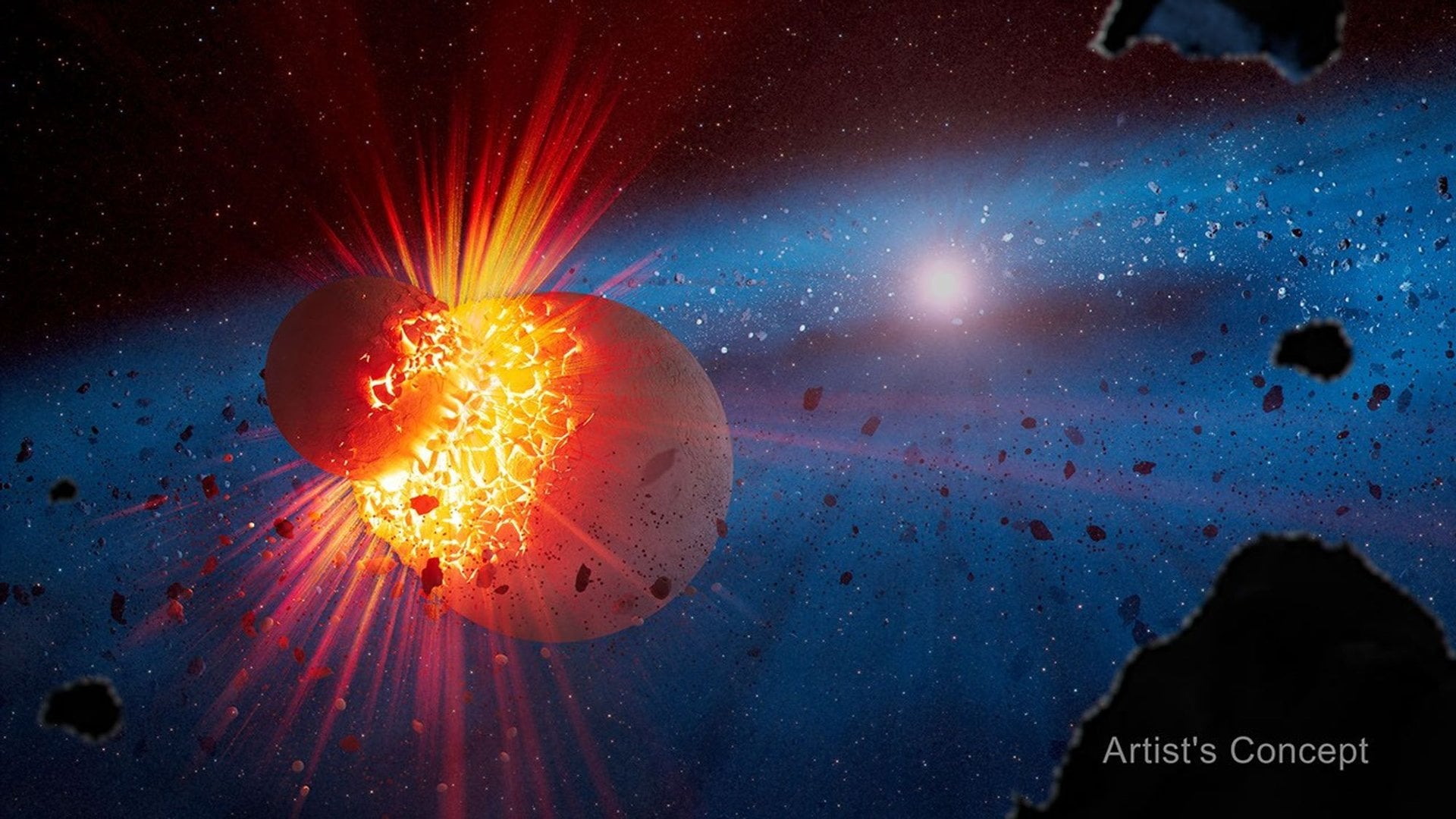
Recent observations by the James Webb Space Telescope (JWST) have revealed extreme debris disks in young star systems, providing a unique window into the early stages of the Solar System. A team of researchers from various institutions, including the Space Science Institute, Konkoly Observatory, and Steward Observatory, used JWST to study these systems and discovered that they are far rarer than previously predicted. Only about 1% of young stars exhibit observable signatures of these extreme debris disks.
The team analyzed 21 such disks, including 12 newly observed disks and 12 previously known ones. They found that eight of these disks are silica-rich, likely produced by high-energy collisions between Mars-sized bodies, while the remaining 13 are silica-poor, indicating less energetic collisions from Moon-sized bodies. Silica-rich disks are only observed around stars younger than 300 million years, while silica-poor disks appear around stars of a broader age range.
These findings support the idea that planets like Earth formed within the first few hundred million years of a solar system's existence, aligning with the estimated age of the Earth-Moon system. The silica-rich extreme debris disks also suggest that our Sun may have undergone a similar phase billions of years ago, consistent with the Late Heavy Bombardment theory.
As the sample size grows, researchers expect to uncover more insights into planet formation and evolution, as well as the broader story of the solar system's formation.
Written by urgent.news from Universe Today's reporting — not their text. Machine-written — may contain errors; check the original before relying on it.