Urgent.News

What's breaking now, across thousands of outlets.

Science

Titanium-polymer metamaterial floats in water

Hybrid open-cell material shows promise for marine infrastructure The post Titanium-polymer metamaterial floats in water appeared first on Physics World .
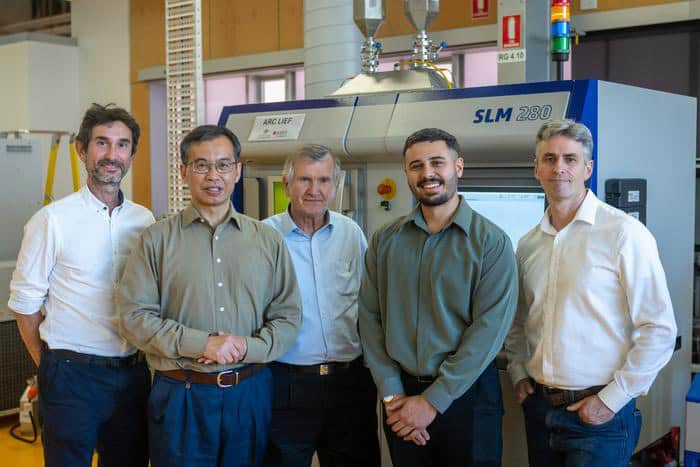
Titanium-polymer metamaterial floats in water

Engineers in Australia and France have developed a novel way to create lightweight, strong, and buoyant structures that can float in water, overcoming the limitations of traditional open-cell metallic materials. By combining titanium alloy with expandable polyurethane foam, researchers have designed hybrid lattice metamaterials that maintain their structural integrity while incorporating water-excluding skeletal density.

This new approach allows for the seamless integration of various materials, leading to potential applications in marine vehicles, floating platforms, and therapeutic devices.

Written by urgent.news from Physics World's reporting — not their text. Machine-written — may contain errors; check the original before relying on it.


Read the original at physicsworld.com →

More in Science

Finding the signatures of chiral spin liquids

Researchers classify chiral spin liquids on the pyrochlore lattice and identify characteristic experimental signatures that could help uncover these elusive quantum states The post Finding the…

  • Chiral spin liquids exhibit continuous collective spin fluctuations at low temperatures.
  • Pyrochlore lattice geometry creates frustration, hindering conventional magnetic order.
  • Emergent gauge fields and spin-like excitations drive different chiral spin liquid behaviors.

Faster fabrication, better performance for PCECs

A nano-precursor synthesis route reduces manufacturing time and cost while improving the performance of protonic ceramic electrochemical cells The post Faster fabrication, better performance for PCECs…

  • Researchers developed PCECs using nano-sized precursor powders
  • Production time reduced from 85 hours to 33 hours
  • PCECs showed 32% higher peak power density and 40% higher electrolysis current density

More from Wednesday 7 October →