Using quantum entanglement to probe hidden properties of quarks
Researchers propose a new way to search for physics beyond the Standard Model by studying quantum-entangled quark pairs produced in electron-positron collisions The post Using quantum entanglement to probe hidden properties of quarks appeared first on Physics World .
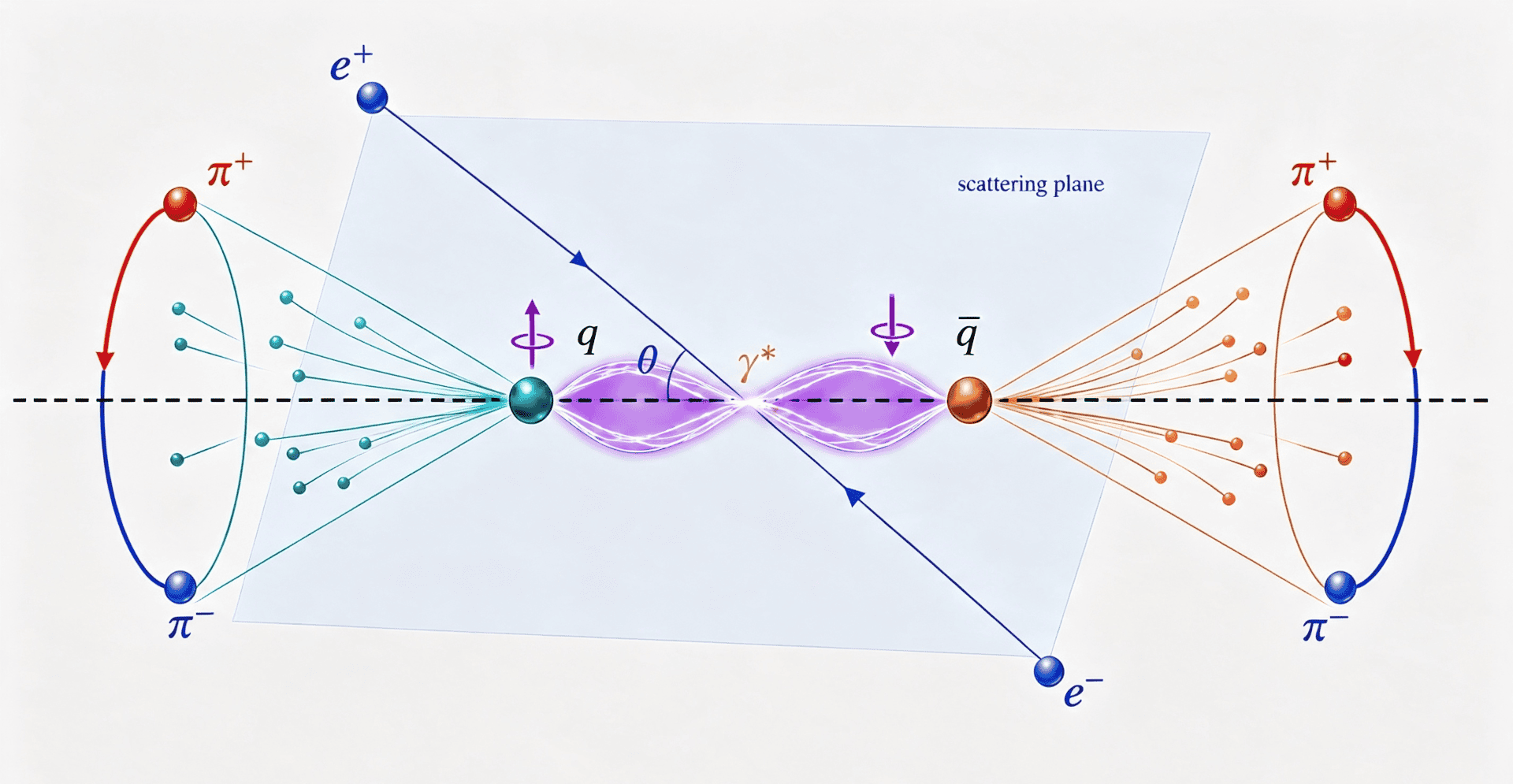
A quark is a fundamental building block of matter, existing in six flavours: up, down, strange, charm, bottom, and top. Quarks combine to form hadrons, which make up most ordinary matter. Electrons belong to a separate family of particles known as leptons and are not composed of quarks. The Standard Model of particle physics is continuously tested to uncover any signs of new phenomena, such as quarks possessing anomalous magnetic or electric dipole moments, which would suggest the existence of physics beyond the Standard Model.
However, quarks are never observed in isolation due to their confinement within particles like protons and neutrons.
In a recent study, researchers have developed a novel method using quantum entanglement to probe the hidden properties of quarks. When an electron and a positron collide, they produce an entangled quark-antiquark pair. If quarks have anomalous magnetic or electric dipole interactions, this would modify the spin correlation of the quark-antiquark pair, resulting in distinct azimuthal angular distributions of the fragmented hadrons.
By analyzing these distributions, information about the spins of the original quarks can be reconstructed, allowing for the detection of any modifications caused by anomalous dipole interactions.
The study demonstrates that this entanglement-based approach offers a complementary method for searching for physics beyond the Standard Model using collider data. Instead of searching for an excess of events, this method probes changes in the spin-correlation structure of the quark-antiquark system, providing a unique way to investigate the electromagnetic properties of light quarks.
Written by urgent.news from Physics World's reporting — not their text. Machine-written — may contain errors; check the original before relying on it.