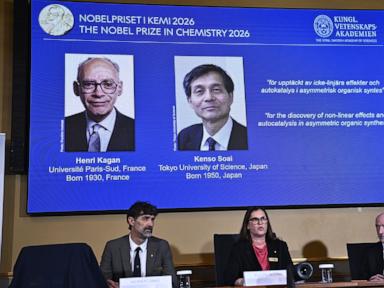
Nobel Prize in chemistry set to be awarded in Stockholm
The Royal Swedish Academy of Sciences will award the Nobel Prize in chemistry
Belgian-American physicist Francis Halzen has been awarded the 2026 Nobel Prize in Physics for his groundbreaking work in creating an observatory to detect high-energy neutrinos, also known as "ghost particles". The IceCube observatory in Antarctica, which he pioneered, uses ice to track neutrinos, which pass through Earth and our bodies with barely a trace.
Eva Olsson of the Royal Swedish Academy of Sciences explained that these particles bring vital information from the cosmos, revealing details about distant galaxies and the processes of exploding stars. Halzen's team of international researchers and engineers has developed a cutting-edge instrument that opens the door to previously unknown cosmic phenomena.
Mark Pearce, chair of the Nobel Committee for Physics, praised Halzen's tenacity and scientific vision for paving the way for a new era in astronomy. The Nobel Prize in Physics is awarded annually by the Royal Swedish Academy of Sciences, with each winner receiving a prize fund of 12 million Swedish crowns ($1.2 million), shared among all laureates if there are multiple winners.
Physics has a prominent place in Nobel's will, having recognized many celebrated figures throughout the decades, including Albert Einstein, Marie and Pierre Curie, Max Planck, and Niels Bohr. The latest prize in physics was awarded last year to John Clarke, Michel Devoret, and John Martinis for demonstrating quantum physics principles in experiments that could advance digital technologies.
Written by urgent.news from MyJoyOnline Ghana's reporting — not their text. Machine-written — may contain errors; check the original before relying on it.
This story
This is one outlet's version. Read the fullest account.
- What if Russia uses nuclear weapons? Can we say Ukraine brought peace to world? Norwegian professor who nominated Zelenskyy and Ukrainians for 2026 Nobel Peace Prize takes on tough questions euromaidanpress.com
- Belgian-American physicist Francis Halzen wins 2026 Nobel Prize in Physics myjoyonline.com
- Sochi’s former mayor reportedly left to fight in Ukraine. Authorities brought him back, and a court has now sentenced him to 15 years for bribery. meduza.io
- Nobel Prize in Physics goes to Francis Halzen for discovering neutrinos, described as 'ghost-like messages from space' dw.com
- 2026 Nobel Prize in Chemistry goes to France's Henri Kagan and Japan's Kenso Soai lemonde.fr
- 🔴Nobel Prize in chemistry awarded to France's Henri Kagan, Japan's Kenso Soai france24.com