This Newly Identified Species of Extinct Crocodile is Missing the Tip of Its Nose, Just Like the Great Sphinx
Learn more about Herugavialis cairensis, an extinct crocodile species whose fossil came from the same rocks as the Great Sphinx.
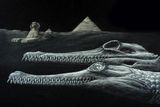
The recently discovered extinct crocodile species, named Herugavialis cairensis, shares a striking resemblance to the missing nose of the Great Sphinx. This discovery was made by an international research team led by the Swedish Museum of Natural History in Stockholm. The fossils, hailing from Egypt's Mokattam Formation, which is also the source of the Great Sphinx's stone, revealed a near-complete skull of an ancient gavial-like crocodile.
This species, previously thought to be a Tomistoma, has been named after the Egyptian god Heru, possibly the inspiration behind the Sphinx. The Mokattam Formation, approximately 45 million years old, is a treasure trove of fossils, including various gavial species that thrived in shallow marine environments during the Middle Eocene.
Despite the erosion and weathering, the Great Sphinx's nose may have lost its tip due to human intervention, possibly during Napoleon's time, instead of natural causes.
Written by urgent.news from Discover Magazine's reporting — not their text. Machine-written — may contain errors; check the original before relying on it.
Also reported by 5 other outlets
- Great Sphinx rocks reveal new species of crocodile thenationalnews.com
- New crocodile species found fossilized in stone used to build Egypt’s Great Sphinx news.mongabay.com
- New crocodile species discovered in rocks used to build the Great Sphinx phys.org
- From the Great Sphinx’s Raw Materials, a New Crocodile Species Surfaces nautil.us
- An extinct crocodilian was found among rocks that built the Great Sphinx sciencenews.org