New crocodile species found fossilized in stone used to build Egypt’s Great Sphinx
About 45 million years ago in northern Egypt, a long-snouted crocodile hunted in the warm, shallow sea. Its bones settled into the same limestone formation that ancient Egyptians would later carry and carve into the Great Sphinx. Now, a century after researchers first dug up the fossils, they say the animal is a species new […]
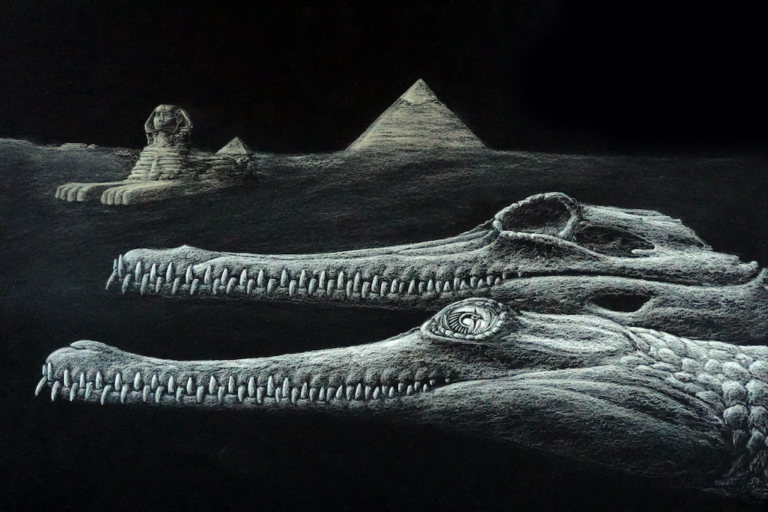
Approximately 45 million years ago, a long-snouted crocodile roamed a warm, shallow sea in northern Egypt. Its remains eventually settled into the same limestone formation that ancient Egyptians later collected and used to construct the Great Sphinx. A century after these fossils were initially unearthed, scientists have determined the extinct reptile to be a previously unknown species.
The fossilized remains of this new crocodile, officially named Herugavialis cairensis, were detailed in a study published in Royal Society Open Science. Much like the Sphinx itself, the fossil lacks the tip of its snout. Co-led by Philip Mannion, a paleontologist from University College London, the research project decided to name the new crocodile after Heru, an ancient Egyptian god, possibly the source of inspiration for the Sphinx.
First discovered in the 1920s within Egypt's Mokattam Formation, the fossils, which include a nearly complete skull, were initially classified as belonging to Tomistoma, the genus of the existing false gharial (Tomistoma schlegelii), due to their similar appearances. However, an international team comprised of researchers from the U.K., Sweden, Germany, and Egypt recently re-examined the fossils using cutting-edge technology.
Led by Paul Burke of the Swedish Museum of Natural History in Stockholm, the team employed CT scans to examine the skulls inside and forthwith discovered distinguishing characteristics that separated Herugavialis cairensis from the false gharial. Herugavialis belongs to a group of long-snouted crocodilians known as gavials, which once thrived worldwide, with many of their fossils uncovered.
Written by urgent.news from Mongabay's reporting — not their text. Machine-written — may contain errors; check the original before relying on it.
This story
This is one outlet's version. Read the fullest account.
- This Newly Identified Species of Extinct Crocodile is Missing the Tip of Its Nose, Just Like the Great Sphinx discovermagazine.com
- Great Sphinx rocks reveal new species of crocodile thenationalnews.com
- New crocodile species discovered in rocks used to build the Great Sphinx phys.org
- From the Great Sphinx’s Raw Materials, a New Crocodile Species Surfaces nautil.us
- An extinct crocodilian was found among rocks that built the Great Sphinx sciencenews.org