Nobel physics prize honours work on 'ghost messengers from space'
Belgian physicist Francis Halzen on Tuesday won the Nobel Prize in Physics for work on subatomic particles at the South Pole, the award jury said. “This year’s prize is about ghostly messengers from space,” Ellen Moons, secretary general of the Royal Swedish Academy of Sciences, told a news conference. Halzen was honoured “for decisive contributions to the IceCube Neutrino Observatory and the…
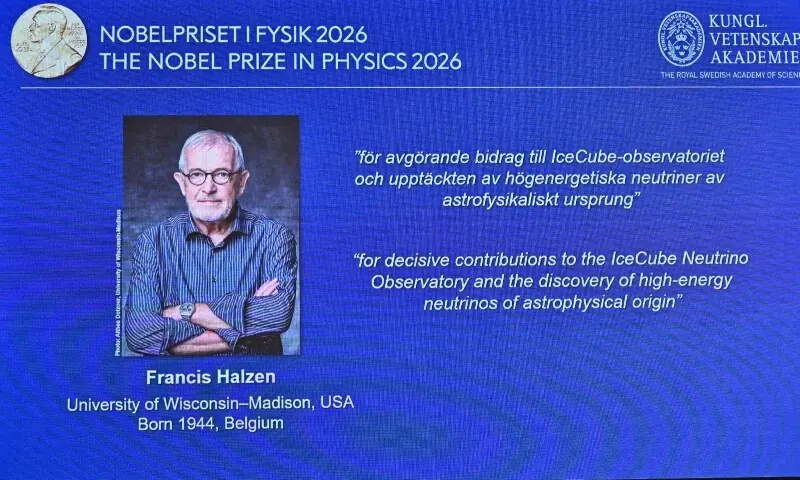
Belgian physicist Francis Halzen was awarded the 2023 Nobel Prize in Physics on Tuesday for his groundbreaking work on subatomic particles known as neutrinos at the South Pole. The award jury described this year's prize as focusing on "ghostly messengers from space". Halzen received the accolade for his "decisive contributions to the IceCube Neutrino Observatory and the discovery of high-energy neutrinos of astrophysical origin".
The Royal Swedish Academy of Sciences highlighted Halzen's "vision and scientific leadership" in building the observatory, which comprises a cubic kilometre of ice equipped with light sensors. These sensors enable the detection of neutrinos produced by extremely energetic events in the distant universe. Professor Eva Olsson, a member of the Nobel Committee for Physics, explained that the observatory serves as "a giant ice cube positioned at the South Pole of our globe".
Halzen, 82, who is a professor at the University of Wisconsin-Madison in the United States, expressed surprise at winning the prestigious award, stating that it was a "great pleasure" to hear the news. The Nobel Prize in Physics is the second award of the season, following the Medicine Prize awarded to US psychiatrist and neurologist Karl Deisseroth and German scientists Peter Hegemann and Georg Nagel on Monday.
The next Nobel Prize to be announced is the Chemistry Prize on Wednesday, followed by the Literature Prize on Thursday and the Peace Prize on Friday. The Nobel Prize ceremony will take place on December 10, the anniversary of the death of scientist Alfred Nobel.
Written by urgent.news from Dawn's reporting — not their text. Machine-written — may contain errors; check the original before relying on it.
This story
This is one outlet's version. Read the fullest account.
- German, US scientists win Nobel prize for work that has helped understand how the brain works dawn.com
- Nobel Physics Prize honours work on ‘ghost messengers from space’ freemalaysiatoday.com
- In Nobel Prize for medicine, a single cell, a flash of light, a breakthrough indianexpress.com
- Explainer-How is the Nobel Peace Prize decided? al-monitor.com
- US-German trio win Nobel medicine prize for work on optogenetics thelocal.se
- 2026 Nobel Prize in Physics awarded to Belgium's Francis Halzen for his work on subatomic particles at the South Pole lemonde.fr
- How light became a remote control for the brain, and won a Nobel Prize euronews.com
- The Nobel for medicine goes to lighting up the brain hindustantimes.com