NASA's Hubble Marks its 200,000th Orbit by Watching Lensed Supernova
NASA’s Hubble Space Telescope completed its 200,000th orbit around Earth on Sept. 19th and marked this milestone with observations that could help refine astronomers' measurements of cosmic expansion (aka. the Hubble Constant).
On September 19th, the Hubble Space Telescope marked its 200,000th orbit around Earth. Throughout its journey, Hubble has traversed over 8 billion kilometers (5 billion miles) and captured more than 1.7 million images of the cosmos. This year, the telescope celebrated its 36th year of uninterrupted service, surpassing the International Space Station by nearly nine years.
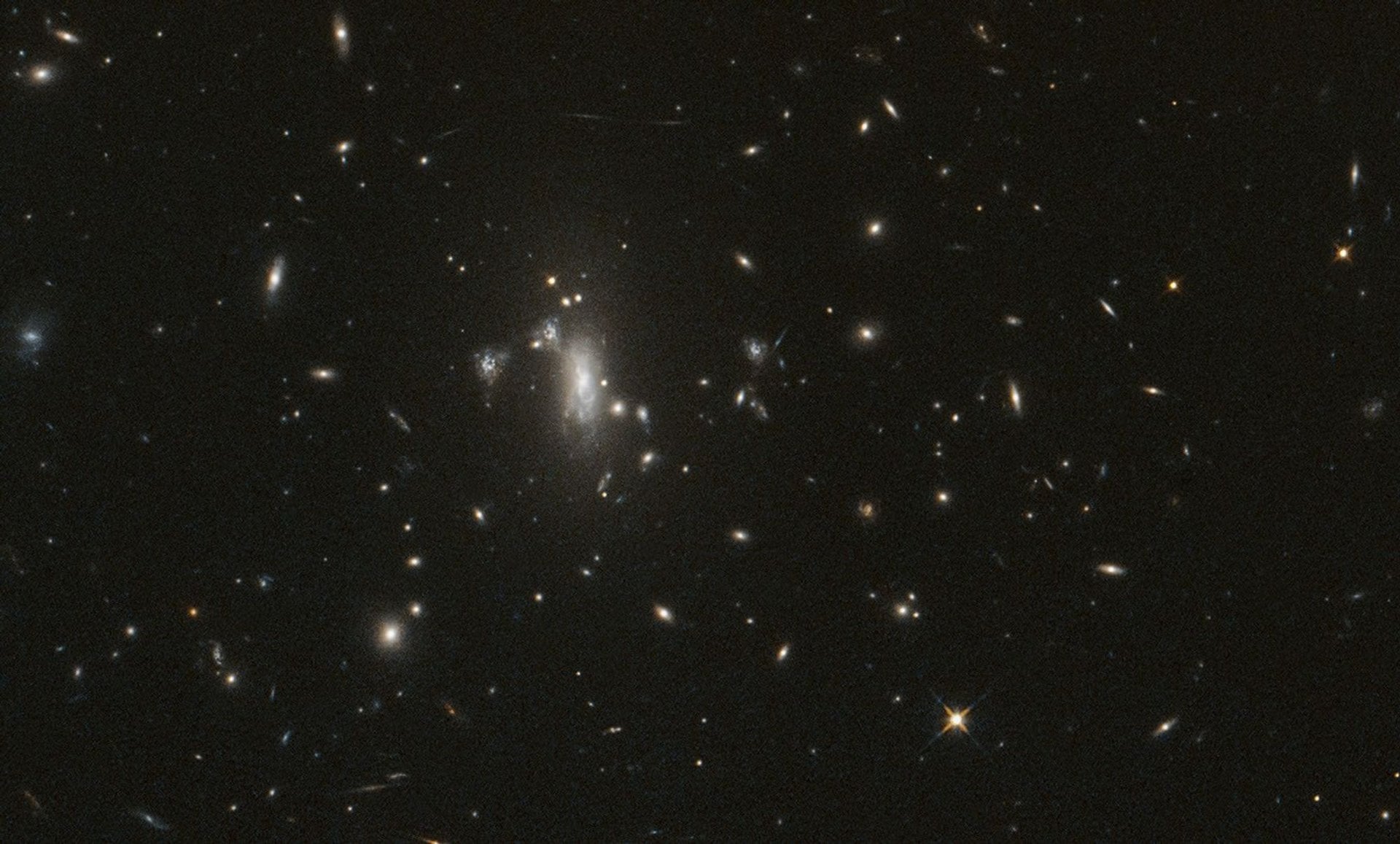
The purpose of Hubble's 200,000th orbit observation was to determine the expansion rate of the Universe, known as the Hubble Constant. The focus of this observation was MACS J0417, a colossal galaxy cluster situated approximately 4.65 billion light-years away in the constellation Eridanus. The scientists hope to reacquire Supernova Athena, a bright explosion discovered by the James Webb Space Telescope (JWST) last year.
Gravitational lensing caused by MACS J01417 distorts and amplifies light from distant sources, making it visible again for Hubble to observe.
Gravitational lenses, such as MACS J01417's, can cause light to arrive at Earth via various paths, leading to the appearance of the same object in multiple locations and at different times. Hubble will keep monitoring MACS J01417 until early March 2027, searching for the reappearance of Supernova Athena. By measuring the timing of its return, astronomers can determine the cluster's mass distribution and calculate the galaxy's recessional velocity, or how fast it's moving away from us.
These measurements aid cosmologists in refining estimates of the Cosmic Distance Ladder and provide more precise constraints on the Hubble Constant.
With over three and a half decades of service, Hubble continues to contribute groundbreaking discoveries to our understanding of the Universe. The telescope's unique ability to observe objects in both visible and ultraviolet light complements the James Webb Space Telescope's capacity to gather light in the infrared spectrum. This teamwork will continue further when the Nancy Grace Roman Space Telescope starts its scientific operations in early 2027.
Written by urgent.news from Universe Today's reporting — not their text. Machine-written — may contain errors; check the original before relying on it.