Fahrradindustrie: Rückkehr des Gründers und WM-Erfolge: So arbeitet sich Fahrradhersteller Canyon aus der Krise
Die Branche hat schwierige Jahre mit Überkapazitäten, Preisschlachten und Insolvenzen hinter sich. Canyon aus Koblenz wächst wieder – nun muss sich die Nachhaltigkeit erweisen.
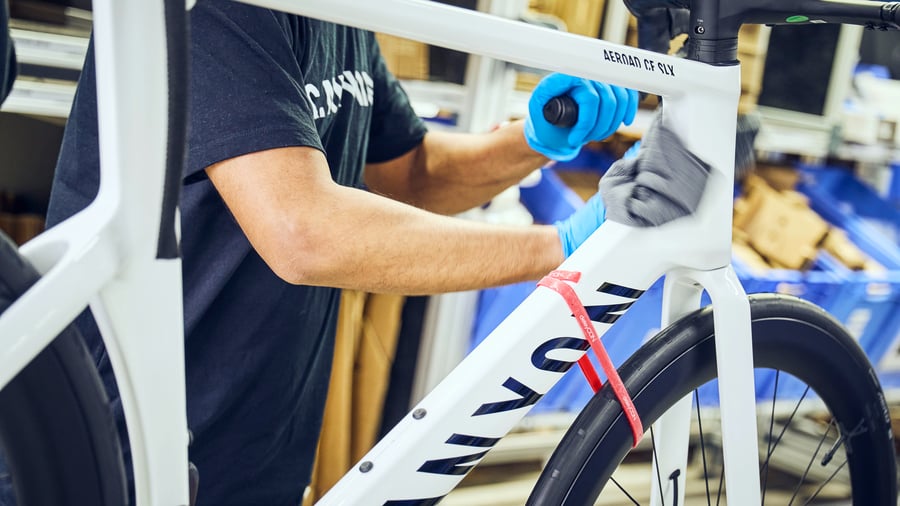
After the Road World Championships in Montreal, Canyon, a German bicycle manufacturer, secured another success. Mathieu van der Poel won the bronze medal in the men's road race on a Canyon bike, while Marlen Reusser claimed gold in the women's time trial on a Canyon bike. In total, cyclists from Koblenz secured six medals. This is a significant boost for the bicycle industry, which is struggling to recover from a deep crisis.
Roman Arnold, the founder of Canyon, returned to the company's operations in September 2025 to steer the turnaround. One year later, the company has made progress. After two years of declining sales, the revenue increased by ten percent in the first half of the year, reaching 427 million euros. The overall result was positive for the first time in the second quarter.
However, Arnold admits that they still need to prove that the turnaround is sustainable. Matthias Meier, who has been leading the company since May alongside Arnold as CEO, stated that they aim to grow sustainably and generate satisfactory returns in the coming years. The bicycle industry crisis is not yet over, even if many inventories have been cleared.
While bicycle sales in Germany increased by ten percent in the first half of the year, the market is regaining momentum. According to Burkhard Stork, the CEO of the industry association ZIV, the sales of bicycles in Germany have fallen for the fifth consecutive year to 3.8 million units, down from 5.0 million at the peak of the boom in 2020.
The hopes for a quick return to such numbers are low. "Perhaps we cannot sell more than four million bicycles in Germany this year," Stork said. The next piece of good news for the industry came in August: the industry giant Accell, which includes brands such as Ghost, Winora, Babboe, Batavus, Raleigh, and Haibike, had to file for bankruptcy.
Other competitors like Simplon, Prophete, and VanMoof had already gone bankrupt in recent years. The crisis in the industry was mainly caused by the COVID-19 pandemic. At the beginning of the pandemic, there was a surge in bicycle demand, but the demand could not be met due to a lack of parts. When bicycles and spare parts became available, the demand was still low, leading to high inventories, discount campaigns, and bankruptcies.
Arnold said that many in the industry were euphoric about the growth they saw, but they were slow to react. Canyon also made a mistake by selling its bikes directly to customers primarily through the internet and its own stores. As a result, the prices became less competitive compared to competitors, who reduced their excess inventories significantly.
This led to losses and declining revenues. Canyon's revenues fell by six percent to 738 million euros last year, resulting in a net loss. Arnold had previously targeted more than one billion euros in revenue for 2025, but insiders in the industry attribute the high optimism to Canyon's ownership structure. With the financial investor GBL backing the company, Canyon sold and marketed its products too quickly.
Rose, a family-owned competitor still operating, fared better during the crisis. Meier refutes this interpretation: "We have a very strong and sustainably oriented investor in GBL by our side." Arnold also denies this view, stating that GBL wants to grow sustainably, in contrast to the entrepreneur. Canyon has managed to turn the corner and is now among the few manufacturers that are at a higher level than before the crisis.
Even during the difficult times, investment continued, such as expanding the test and inspection department in Koblenz and building a new e-bike center. Although operational costs had to be reduced, Canyon now employs 1,300 people, down from 1,700. Development and assembly will remain central in Germany. "We have no intention of leaving our production site in Koblenz," Arnold said.
Canyon aims to maintain its product expertise and close relationship with customers. Arnold wants to focus on bicycle expertise and the core of the bike business. He calls this approach "Pure Cycling."
Written by urgent.news from Handelsblatt's reporting — not their text. Machine-written — may contain errors; check the original before relying on it.