Chinese scientists build world’s smallest CT scanner, weighing just 6kg
Chinese researchers have developed the world’s smallest CT scanner, a portable device designed to produce images of tiny fossils and archaeological relics. Built by the Shandong province-based Rayim, the Xtomo-Cube is about the size of a desktop speaker and weighs just 6kg (13.2lbs). “The device can be held in one hand and is the world’s smallest and lightest CT system, earning it the nickname…
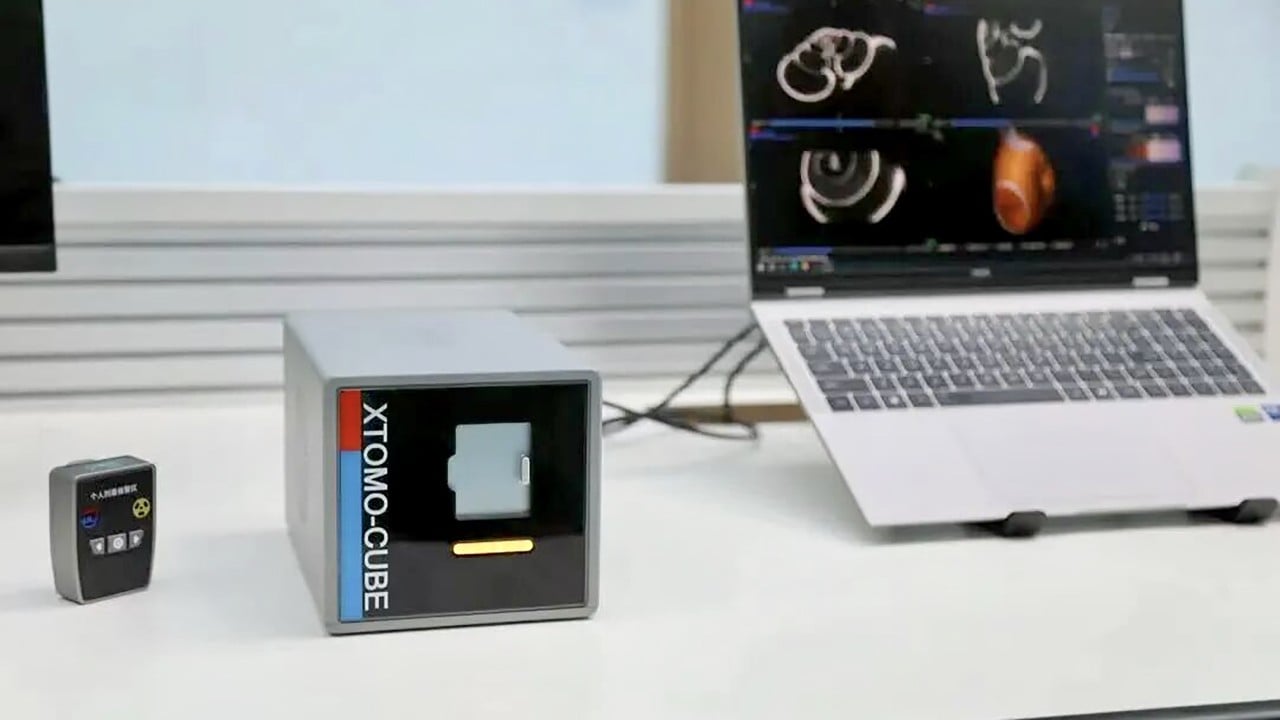
Chinese scientists have developed the world's smallest CT scanner, named the Xtomo-Cube. Developed by Rayim in Shandong province, this portable device is about the size of a desktop speaker and weighs just 6kg. Liu Baodong, a senior engineer at the Chinese Academy of Sciences, described the device as "palm-sized CT scanner" due to its compact size and light weight.
The Xtomo-Cube boasts a spatial resolution of 80 micrometres, allowing it to analyze objects as small as snail shells and medicine capsules. The machine consumes only 200 watts of power, making it easy to power during fieldwork using a portable power bank. All key components, including the X-ray source, rotating platform, and detector, were designed and manufactured in China.
The previous record holder for the smallest CT machine was a 19kg German-developed device. CT scanners work by using X-rays taken from multiple angles to create detailed 3D models of an object or organism's internal structure. First introduced in 1971, CT scanners have since become widely used in hospitals for various medical purposes.
Despite their expanding uses, CT scanners have traditionally been large, heavy machines. However, the Xtomo-Cube breaks this trend with its compact size and low-energy X-rays, making it suitable for use in university classrooms and research labs.
Written by urgent.news from Reuters Business via SCMP's reporting — not their text. Machine-written — may contain errors; check the original before relying on it.