Chimpanzees give youngsters the tools to learn tricky techniques
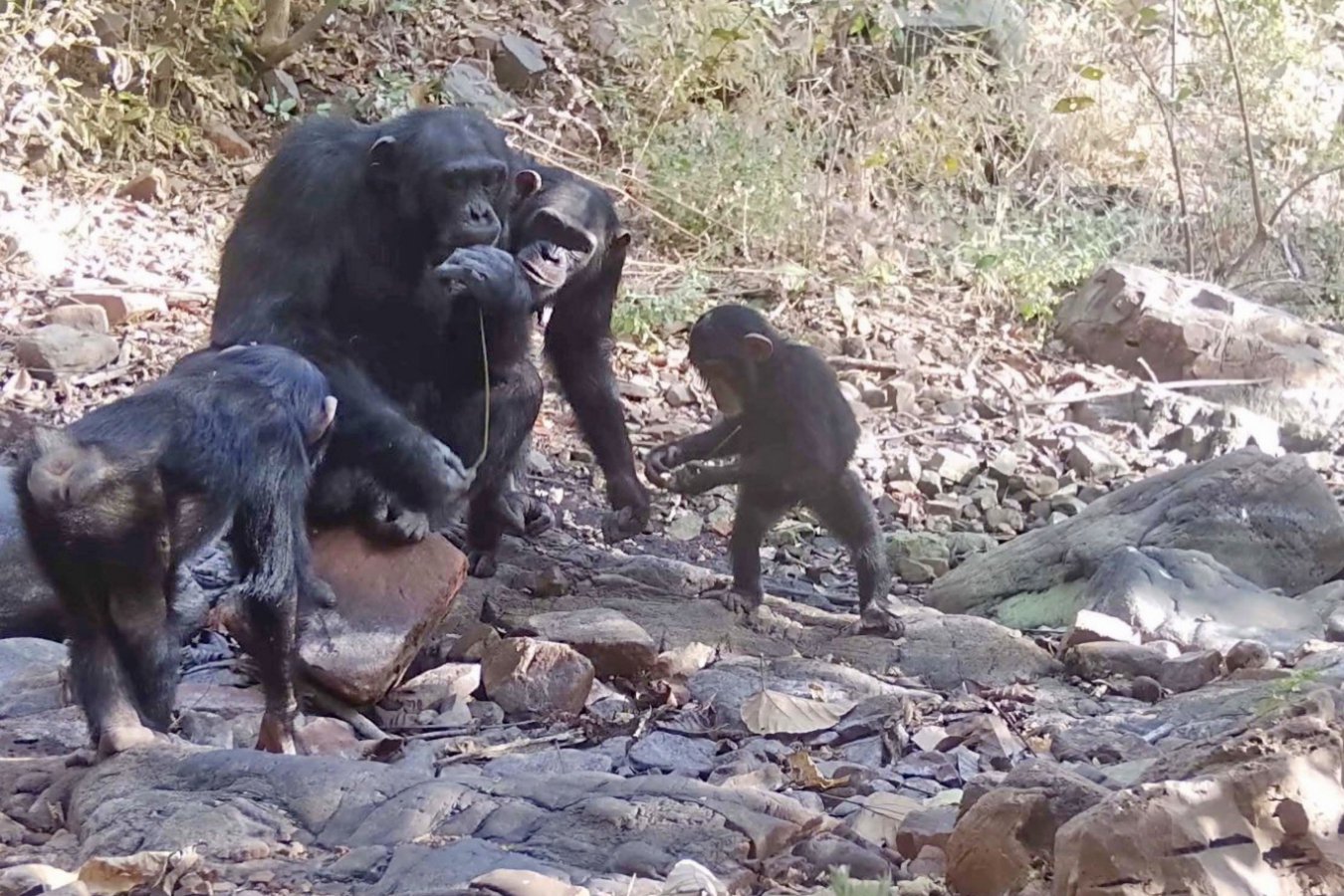
Two-thirds of a century after Jane Goodall observed "David Greybeard" break off a twig to fashion a fishing rod for termites, researchers following in her footsteps have found that adult chimpanzees in Senegal literally hand youngsters the tools for learning.

Over six decades after Jane Goodall witnessed David Greybeard fashioning a termite fishing tool, researchers have discovered that adult chimpanzees in Senegal actively teach youngsters the skills to use challenging techniques. Darwin once noted in 1871 that chimps employ stones for cracking nuts, challenging human self-importance.
Throughout the 20th century, a select number of creatures, including octopuses and parrots, have demonstrated tool-making and usage. However, like Darwin's observation, tool use appears to have evolved more often among monkeys and apes. For instance, chimps are known to create leaf sponges for extracting liquids, fashion sticks for gathering algae, and sharpen spears for hunting.
In a new study published in Frontiers in Psychology, researchers led by Andreu Sánchez-Megías, a doctoral candidate at the University of Barcelona and the Jane Goodall Institute Spain, have demonstrated that receiving food and tools from experienced individuals, termed "food or tool transfer," may aid chimpanzees in learning to utilize technology to access difficult-to-obtain foods. According to Sánchez-Megías, mothers are primarily responsible for modeling and teaching this behavior to young chimpanzees.
The researchers studied wild western chimpanzees (Pan troglodytes verus) at the Dindefelo savanna site in Senegal, analyzing nearly 15 hours of footage from camera traps installed at 14 locations where chimps were known to use tools, such as algae, army ants, and fungus-growing termites. They also collected 30 minutes of footage from cameras at 11 sites where chimps frequently pounded baobab fruit against stationary stone anvils.
The study recorded 33 instances of tool transfer from one chimpanzee to another and four instances of fruit transfer. Most (58%) of the original tool or fruit owners were adults, particularly females, while the majority of recipients (42%) were infants rather than juveniles or adults. Most transfers occurred from relative to relative, with 30% being from mother to offspring.
The study found that most tool transfers took place from skilled adults, especially mothers, to inexperienced individuals, including mother-offspring pairs and other relatives. Teaching is one of the strategies chimpanzees employ to transfer information and skills between individuals. This behavior requires an active role from the teacher, who must adapt their behavior to facilitate information transmission to the learner.
The researchers suggest that teaching may evolve to transfer complex information that cannot be acquired through simpler mechanisms, such as individual or observational learning.
Written by urgent.news from Phys.org's reporting — not their text. Machine-written — may contain errors; check the original before relying on it.