China’s memories of Mao fade to nostalgia 50 years after his death
Mao ushered in collectivized ownership hoping to drive industry and unite the country, but his drastic policies are blamed for mass starvation and millions of deaths.
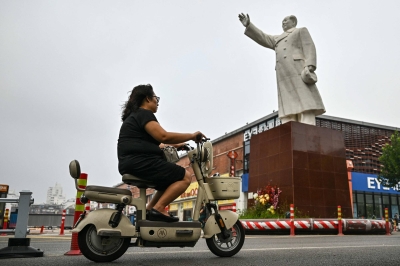
In Nanjie village, located in central Henan province of China, a square adorned with crimson flags stands as a poignant reminder of Chairman Mao Zedong, whose memory continues to hold sway over the community almost 50 years after his demise. Standing tall, the statue of Mao, pristine and gleaming white, draws both tourists and locals alike, who gather to pay homage to the former Communist leader.
Despite the passage of time, the Great Helmsman remains a central figure in Nanjie, often dubbed "China's last Maoist village." Nostalgia for Mao's egalitarian ideals is on the rise in China as memories of his turbulent rule begin to fade and the country grapples with an economic slowdown and growing inequality. Mao, who spearheaded the 1949 communist revolution, championed collectivised ownership to drive industry and unite the nation.
However, his radical policies are also blamed for mass starvation and millions of deaths by historians.
While the Chinese Communist Party still regards Mao as a revolutionary hero, it publicly acknowledged after his death that his Cultural Revolution was a "grave mistake." This admission, like that of subsequent leaders, aligns with the consensus reached by historians. In Nanjie, the influence of Maoist principles of shared ownership persists among residents, who still live under these economic tenets while the rest of the nation has long moved beyond such policies.
Local residents, such as Xie Kaiyue, a 22-year-old university student, still hold a deep reverence for Mao, despite having been born nearly three decades after his death. She believes that young people in the village, including herself, are less resilient than those of the past. The village's uniform apartment blocks, plastered with socialist slogans, serve as a direct link to Mao's era, with guides explaining how cooperative ownership in local enterprises helps fund free housing for residents.
Further north, in the mountain village of Dazhai in Shanxi province, tourists reminisce about the era when Mao was hailed as a national model. After locals transformed arid hills into irrigated fields, Mao's influence permeated political and social life. However, the once-pure spirit of Mao's struggle against hardship is now tinged with regret for the Great Famine, which the government claims killed around 15 million people, though historians estimate the toll to be between 20 and 43 million.
Public discussions of Mao's darker chapters are tightly controlled, with references to the Cultural Revolution strictly censored in the public sphere. In one museum, the text detailing the Cultural Revolution has been crudely scraped off signage, reflecting the party's strict control over historical narratives. Scholar Xu Chenggang, who was targeted as a child in Beijing during the Cultural Revolution, laments the lack of freedom to discuss such sensitive topics.
Mao's image graces banknotes, his portrait overlooks Tiananmen Square, and his preserved body rests in a mausoleum. Public discussion surrounding Mao has been further stifled under current leader Xi Jinping, who warns against "historical nihilism," or narratives that contradict the party's own history. Despite these efforts to sanitize history, a romanticised interpretation of Mao has emerged among younger generations frustrated by long working hours and intense competition in education and the job market.
A viral video series on Bilibili, a popular platform among those under 30, even drew parallels between the 2017 movie 'Youth' and the Cultural Revolution, praising Mao and blaming capitalist elites for the movement's downfall. However, these videos were swiftly removed after garnering over 35 million views in less than a week.
Written by urgent.news from Hong Kong Free Press's reporting — not their text. Machine-written — may contain errors; check the original before relying on it.
This story
This is one outlet's version. Read the fullest account.
- China’s memories of Mao fade to nostalgia 50 years after his death hongkongfp.com
- China’s memories of Mao fade to nostalgia 50 years after his death freemalaysiatoday.com