Astronomers Hear the Faint Whispers of Cosmic Hydrogen from the Distant Past.
Astronomers have directly detected an extremely faint radio signal from hydrogen gas billions of light years away, demonstrating a powerful new way to map the Universe.
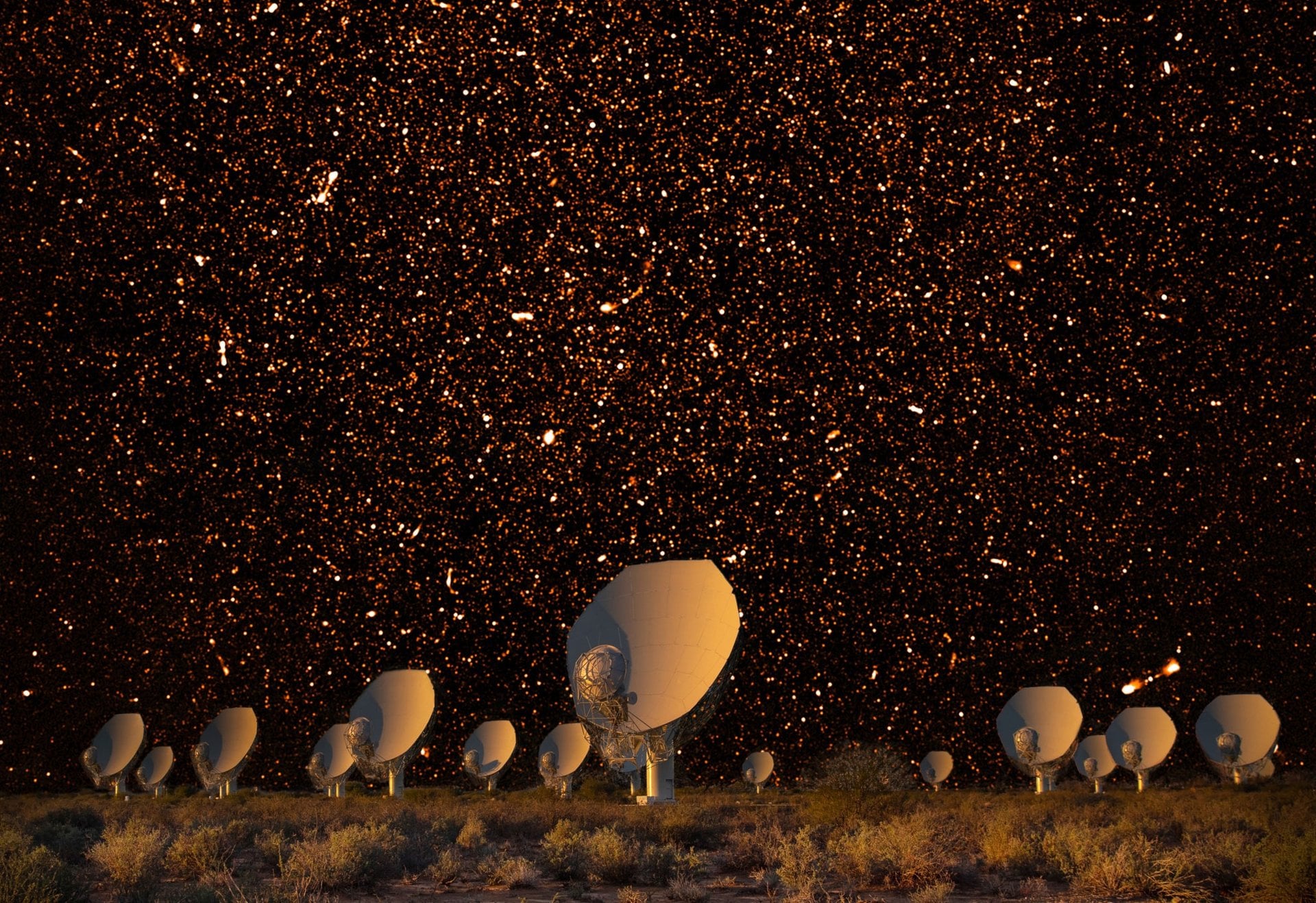
Astronomers have detected faint radio signals from ancient hydrogen gas using the MeerKAT telescope, marking a significant milestone in the study of cosmic hydrogen, galaxy formation and evolution, and transient radio sources. This discovery, published in The Astrophysical Journal Letters, demonstrates the potential of Hydrogen Intensity Mapping (HIM), a technique that allows astronomers to efficiently study vast regions of the cosmos.
The MeerKAT telescope, located in South Africa, was built to study cosmic hydrogen and has now shown it can directly detect weak radio signals from billions of years ago. The research team, led by Sourabh Paul from the University of Manchester, identified two signals emitted by neutral hydrogen at redshifts of 0.32 and 0.44, which correspond to distances of 3.67 and 4.76 billion light-years from Earth.
These observations correspond to when the Universe was approximately 9 and 10 billion years old, respectively. This achievement represents a breakthrough in the field of cosmology, as it confirms the viability of HIM as a practical tool for mapping the Universe. The detection was made possible by analyzing 96 hours of data collected by MeerKAT in 2018 and highlights the potential for further discoveries in the observatory's archival data.
The study also underscores the importance of MeerKAT in future cosmological surveys, as it will be combined with data from the Square Kilometer Array Observatory (SKAO) to enable more detailed investigations of galaxy formation, the role of Dark Matter and Dark Energy, and the evolution of the Universe.
Written by urgent.news from Universe Today's reporting — not their text. Machine-written — may contain errors; check the original before relying on it.