Zombie fungus uses dead female flies to infect healthy flies using spores
A fungus launches infectious spores using pressurized liquid bursts from dead flies. These spores are propelled with significant force, reaching speeds up to ten meters per second. Spore size is crucial, balancing momentum for dispersal and air current transport. Dead female flies attract males, aiding spore spread through contact and movement. This remarkable fungal artillery ensures continued…
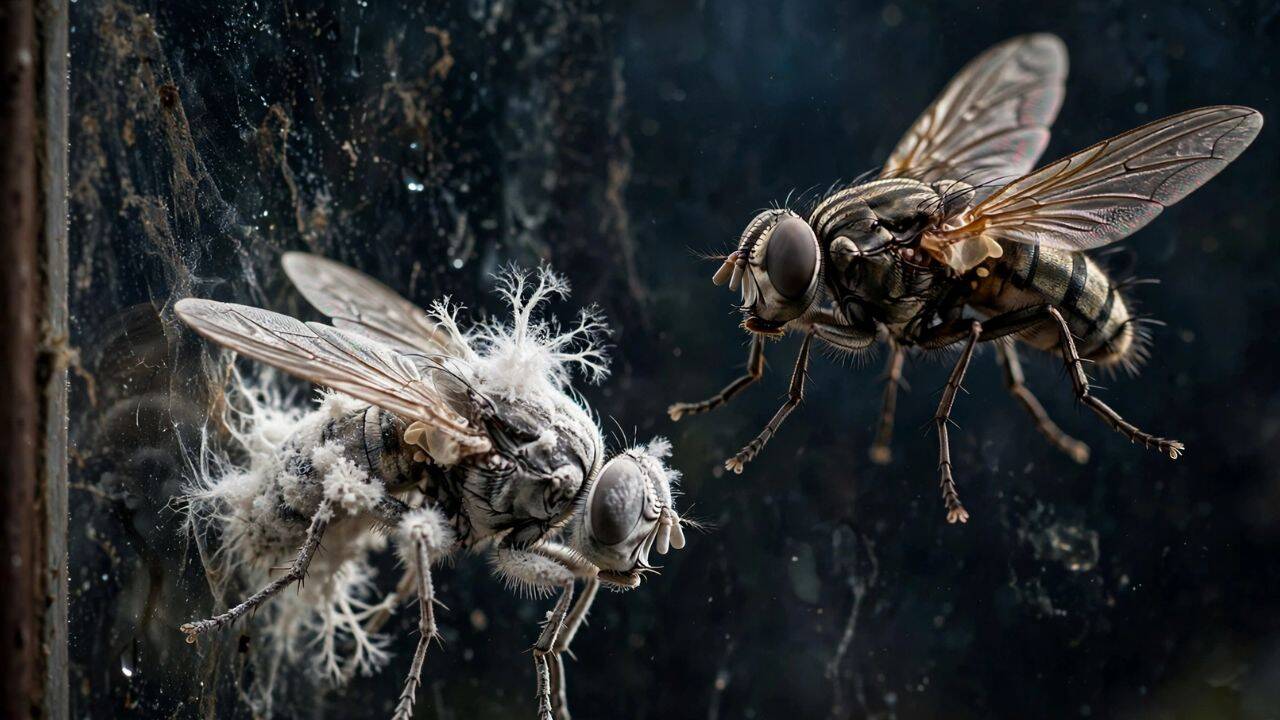
Entomophthora muscae, a fungus that preys on house flies, has developed an ingenious method to disperse its spores to reach new hosts. Once inside a deceased fly, the fungus produces minuscule stalks that sprout from its body, each carrying a single spore at the tip. Rather than simply releasing the spore, the fungus forcefully expels it in a burst of liquid, a mechanism likened to a "soft water cannon" in a recent study published in the Journal of the Royal Society Publishing.
This launch is a result of pressure gradually building inside the stalk until it breaks at a weak point, propelling the spore into the air with considerable force. The researchers employed high-speed videography and a biomimetic 'soft cannon' model to study this unique launch mechanism, discovering that the pressure in the stalk reaches a breaking point, which then forces the spore out.
The effectiveness of this spore dispersal is highly dependent on the spore's size. The spore must be large enough to overcome the resistance of the thin layer of still air surrounding the dead fly but not so large that it hinders the natural air currents that could carry it away. The researchers found that a spore should ideally be around 10 micrometres in size to effectively navigate this layer, though it can still travel if larger, up to approximately 40 micrometres, before being effectively dispersed by air currents.
The fungus's spores, typically measuring around 26 micrometres in width by 30 micrometres in length, perfectly fit within this optimal size range, ensuring they can move effectively away from the dead fly and increase their chances of reaching another house fly. This meticulous size regulation is crucial for the fungus's survival and propagation, allowing it to use its dead hosts as stepping stones to infect other flies.
Written by urgent.news from Times of India's reporting — not their text. Machine-written — may contain errors; check the original before relying on it.