The First Battery Was Inspired By a Dead Frog
In a display case on the lower level of the Faraday Museum at the Royal Institution in London, there’s an unassuming stack of gray metal discs and blotting paper. It’s not at all obvious that this humble object is the starting point of today’s multibillion-dollar global battery industry. The object’s invention in 1799 grew out of a disagreement that Alessandro Volta —the Italian physicist for…
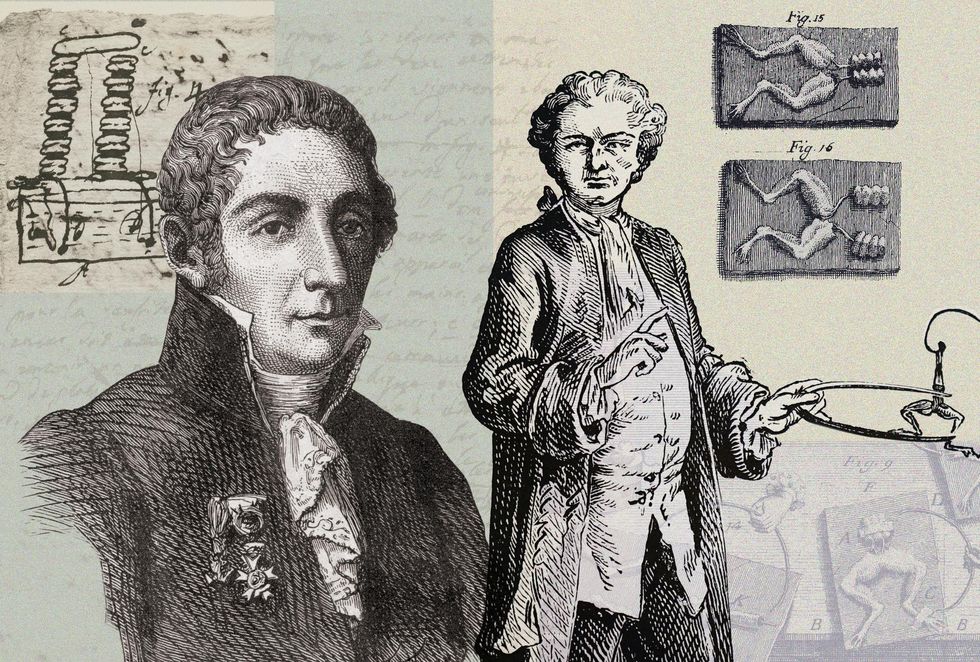
The humble stack of gray metal discs and blotting paper in the Faraday Museum's display case holds the key to the world's first battery, which emerged in 1799. This innovative device grew out of a bitter dispute between Italian physicist Alessandro Volta and his friend Luigi Galvani over the phenomenon of "animal electricity." Galvani, a respected physician, had studied the electrical stimulation of frog legs in the 1770s, believing the muscle contractions were caused by an innate "animal electricity" within the animal.
Volta, chair of physics at the University of Pavia, initially sided with Galvani but later concluded that the frog itself generated no electricity. Instead, Volta proposed that the charge came from two different metals in contact with the frog, which he termed "metallic electricity." To prove his point, Volta invented an "artificial electric organ" consisting of stacked discs of alternating copper and zinc, separated by cardboard or blotting paper soaked in brine or acid.
This stack generated its own electricity through a chemical reaction, delivering a sustained low-current output.
The voltaic pile, named after Volta, immediately challenged the prevailing scientific understanding. Just six weeks after Volta announced his invention to the Royal Society in 1799, English scientists William Nicholson and Anthony Carlisle used a voltaic pile to split water into hydrogen and oxygen, discovering chemical electrolysis. Humphry Davy later used large piles to isolate various elements, including potassium, sodium, calcium, strontium, and barium.
Despite its initial limitations, the voltaic pile proved to be the first true battery. However, the story of Galvani and Volta is nuanced. While Volta is often portrayed as the clear winner in the debate over animal versus metallic electricity, they both contributed to the understanding of electrical phenomena. Galvani was correct about electrical signals causing muscle contractions, but Volta was right to question the existence of an "animal electricity" force.
Written by urgent.news from IEEE Spectrum's reporting — not their text. Machine-written — may contain errors; check the original before relying on it.