Scientists discover massive 'thermal anomaly' beneath the surface of Mars
New research into the interior of Mars further emphasizes that the Red Planet is a world of two very different halves.
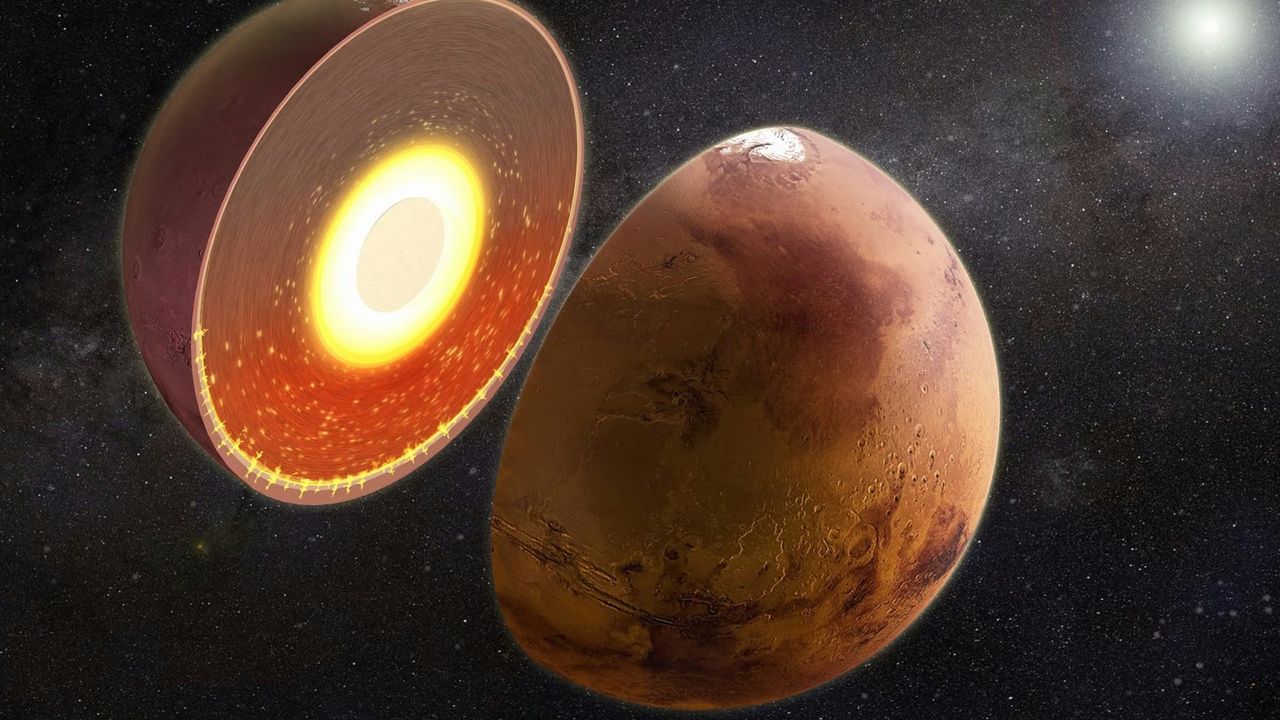
Scientists have uncovered a substantial thermal anomaly beneath the surface of Mars, suggesting the Red Planet features two drastically different halves. The southern hemisphere's temperature is up to 750 degrees Fahrenheit (400 degrees Celsius) warmer than the northern side, challenging previous assumptions about Mars' spherical symmetry.
Alexander Berne, the lead author and former Caltech researcher now at the University of Arizona, employed a technique called tidal tomography to analyze data from three NASA spacecraft – Mars Global Surveyor, Mars Odyssey, and Mars Reconnaissance Orbiter. This allowed the team to infer a model of Mars' interior structure and temperature, revealing the mantle beneath the southern hemisphere is significantly warmer than the northern mantle.
This discovery has implications for Mars' habitability and volcanic activity history. The north of Mars is characterized by lowland plains, while the southern crust is thicker and covered by cratered highlands, possibly once hosting a large ocean. The thermal anomaly could explain NASA's InSight lander's findings about seismic waves dissipating more quickly in the south and magnetic anomalies found in iron-bearing minerals.
While the cause of the north-south divide remains unclear, it may have resulted from an ancient giant impact over four billion years ago, with variations in crust thickness affecting heat distribution. Future missions could utilize the tidal tomography technique to gain further insights into the interiors of other celestial bodies.
Written by urgent.news from Space.com's reporting — not their text. Machine-written — may contain errors; check the original before relying on it.
This story
This is one outlet's version. Read the fullest account.