Roman lifts off on a mission to survey the infrared sky
Image: NASA’s Nancy Grace Roman Space Telescope lifted off on a SpaceX Falcon Heavy rocket from NASA’s Kennedy Space Center in Florida, USA, at 07:26 EDT / 12:26 BST/ 13:26 CEST on 30 August 2026. With the successful launch, Roman began its mission to survey the sky in visible to near-infrared light to help reveal the nature of dark energy and dark matter. The telescope will also investigate the…
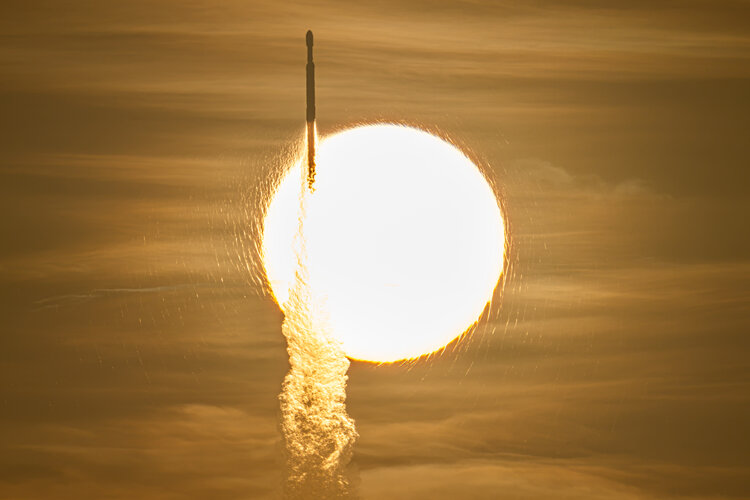
On 30 August 2026, NASA's Nancy Grace Roman Space Telescope embarked on its journey to survey the infrared sky, launching from NASA's Kennedy Space Center in Florida aboard a SpaceX Falcon Heavy rocket. With this successful mission, Roman is set to delve into the mysteries of dark energy and dark matter, as well as investigate the diverse exoplanets within our galaxy.
The European Space Agency (ESA) contributed crucial components, including star trackers, batteries, and detectors for the coronagraph instrument, and will offer communication support via its deep-space network.
The Roman Space Telescope, a NASA-led endeavor, boasts a 2.4-meter primary mirror and two instruments: the Wide Field Instrument (WFI) and a Coronagraph Instrument technology demonstration. Its panoramic view of the sky, coupled with its sharp infrared vision and swift re-orientation, allows Roman to conduct rapid and efficient surveys over vast areas.
By mapping the clustering of galaxies and studying the light from thousands of distant type Ia supernovas, scientists hope to trace the expansion of the Universe and determine whether dark energy remains constant or evolves over cosmic time, both scenarios carrying significant implications for our understanding of the cosmos.
ESA's Roman Project Scientist, Bethan James, expressed excitement for the telescope's potential to uncover thousands of new worlds, including cold planets and free-floating planets, previously undetected. Once in its designated orbit around the second Sun-Earth Lagrange point (L2), approximately 1.5 million km away from Earth, Roman will have an unobstructed view of nearly 12% of the sky.
In the three months following launch, the Roman team will conduct necessary deployments, calibrations, and tests before commencing science operations. The mission will continue for at least ten years, making significant strides in advancing our knowledge of the Universe.
Written by urgent.news from ESA Space Science's reporting — not their text. Machine-written — may contain errors; check the original before relying on it.