How a star with an extreme magnetic field could prove space is not empty
The work could prove the ‘nothingness’ of space is actually a complex and active medium and help scientists refine their maps of the universe
In the 1930s, German physicists Heisenberg and Euler posited that empty space is not truly empty, but behaves like a crystal when subjected to a strong magnetic field. This prediction, known as vacuum birefringence, remains unconfirmed due to the immense strength of magnetic fields required. However, a recent study published in Nature details how astronomers from multiple countries have observed potential evidence of vacuum birefringence using two satellites and a telescope in Australia.
Vacuum birefringence occurs when light passing through a magnetic field splits into different paths based on the direction of its electrical field vibration. In quantum electrodynamics (QED), a vacuum is a sea of virtual particles that constantly appear and disappear, which normally have a negligible effect on light. However, under the right conditions, these particles' behavior changes, causing light to polarize differently depending on the magnetic field's strength.
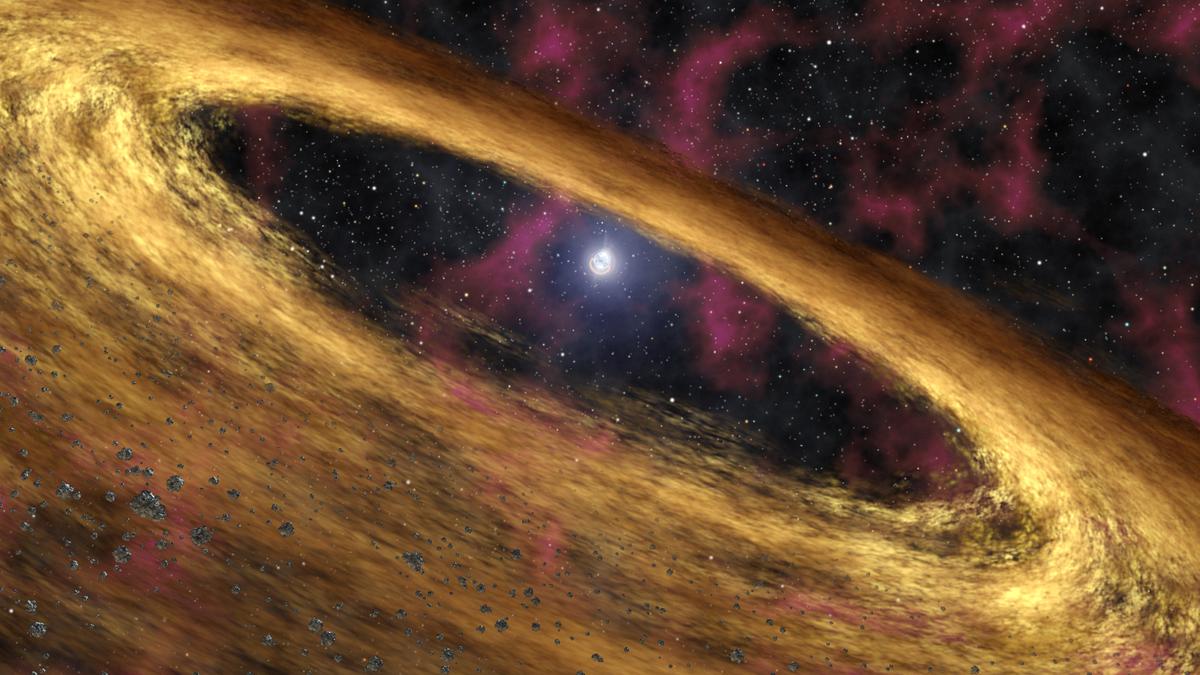
The study focused on a magnetar named 1E 1547.0-5408, located 14,700 lightyears away. Magnetars are the remnants of dead stars that possess extremely powerful magnetic fields. By combining X-ray and radio frequency measurements, the international team was able to map the magnetar's magnetic field geometry. The team detected very high levels of polarisation in X-rays, up to 80% in some instances, which is a strong indicator of vacuum birefringence.
This polarisation occurs because the electric field of X-rays from the magnetar aligns itself with the magnetic field lines, effectively locking it into one of two directions. As the X-rays travel through space, their polarisation remains fixed even as the magnetic field weakens. The team also noted that the polarisation decreased as the X-rays increased in energy, a prediction made by QED.
The findings provide strong evidence that space is not an empty vacuum but a complex, active medium that can be manipulated by both gravity and magnetism. The team plans to further probe the nature of vacuum polarization, requiring coordinated astronomical campaigns observing multiple magnetars and covering a wider spectrum of the electromagnetic spectrum.
Written by urgent.news from The Hindu - Sci-Tech's reporting — not their text. Machine-written — may contain errors; check the original before relying on it.