Spy to space: The science behind NASA’s Roman Space Telescope
As NASA prepares to launch its new Nancy Grace Roman Space Telescope this weekend, Rochester Institute of Technology’s Prof Don Figer examines the telescope’s purpose and its origins in US spycraft. Read more: Spy to space: The science behind NASA’s Roman Space Telescope
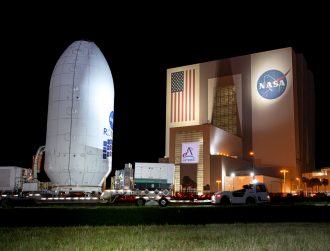
NASA's Nancy Grace Roman Space Telescope, housed within its payload fairing, was transported from the Payload Hazardous Servicing Facility to the SpaceX hangar at Launch Complex 39A at NASA's Kennedy Space Center on Tuesday (August 25). This new telescope, set to launch this weekend, will survey a billion galaxies, helping astronomers trace the universe's evolution over time.
Originating from America's spy program, the telescope was initially developed by the National Reconnaissance Office but was later transferred to NASA in 2012 when the intelligence agency no longer required it.
Over the course of a decade, NASA has modified the telescope, aiming for a launch as early as August 30, 2026. The Roman Space Telescope is designed to study the three-dimensional distribution of dark matter, detect exploding stars called supernovas, and monitor small variations in light from stars near the Milky Way's center to infer the presence of rogue planets. Additionally, its coronagraph instrument will test technology for detecting Earth-like planets around other stars.
The Roman Space Telescope's ability to capture a large swath of the sky at once, thanks to its wide field of view, is a direct result of its origins in spy technology. This feature allows it to see much larger fields compared to other space telescopes that focus on deep observations. Its camera has an unusually fast optics due to its spy telescope roots, allowing it to project a larger piece of sky onto the telescope's focal plane.
The telescope's mirror, about the same diameter as Hubble's, can capture an area about a hundred times larger per image.
A significant modification made by NASA includes the creation of a large focal plane, composed of 18 wide-area near-infrared detectors. These detectors are similar to those in the James Webb Space Telescope but have four times the number of pixels, totaling around 300 megapixels. These detectors enable the telescope to detect faint signals from planets, stars, and galaxies in the infrared spectrum, which has longer wavelengths than visible light.
The vast potential of the Roman Space Telescope stems from its advanced technology, which was developed over decades. The telescope's detectors represent the culmination of a long history of technological advancements, with roots tracing back to the early 1970s when charge-coupled devices (CCDs) were invented, leading to the Nobel Prize in 2011 for physicists who inferred the existence of dark energy.
The technology behind Roman's detectors has contributed to numerous Nobel Prizes and continues to pave the way for future astronomical discoveries.
Written by urgent.news from Silicon Republic's reporting — not their text. Machine-written — may contain errors; check the original before relying on it.
This story
This is one outlet's version. Read the fullest account.
- In 1962, NASA blew up a water tank 65 miles above Earth to study the atmosphere timesofindia.indiatimes.com
- Space Math at NASA: Problems Related to CMEs and Flares science.nasa.gov
- NASA administrator suggests putting data centers in space thehill.com
- NASA Has Started the Count Down to the Launch of the Nancy Grace Roman Space Telescope nautil.us
- After failure of private rescue mission, NASA's Swift space telescope will crash back to Earth. But when and where? space.com
- NASA chief outlines plans to build moon base in space race with China cbsnews.com
- NASA’s Roman Space Telescope will rewrite how we study the universe scientificamerican.com
- NASA is gearing up to launch its next flagship space telescope – combining spy technology with sophisticated infrared detectors theconversation.com