Planets Hurry To Form Before the Protoplanetary Disk Dissipates
Planets form in protoplanetary disks, reservoirs of gas and dust around young stars. But young stars are a little hyperactive, and they emit powerful winds that can dissipate the gas. So planets, especially gas giants, are in a race against time to form. They only have a few million years before the gas is gone.
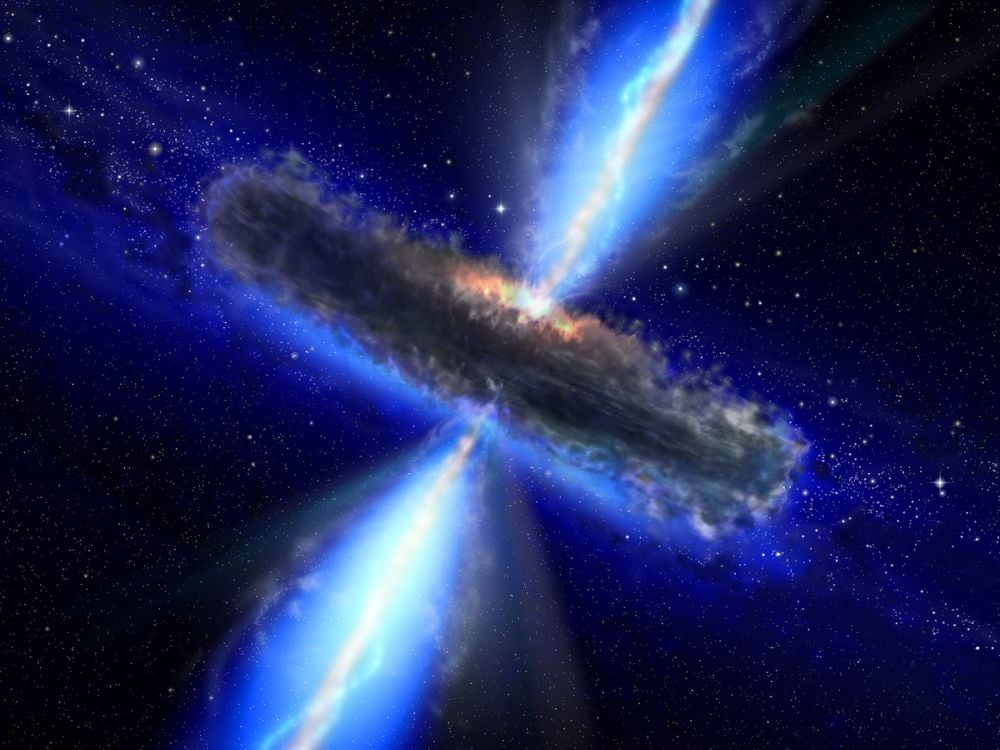
The James Webb Space Telescope (JWST) plays a crucial role in studying planet formation within disks surrounding young stars. These disks do not exist indefinitely; their gas dispersal significantly impacts planet formation. Two primary processes disperse protoplanetary disks: powerful magnetic fields and atomic winds, including photoevaporative winds.
A new study published in The Astronomical Journal employs JWST data to analyze how various winds disperse gas within planet-forming disks. The research, led by Naman Bajaj from the University of Arizona's Lunar and Planetary Laboratory, highlights the significance of understanding how mass-loss processes coevolve with planet formation to accurately constrain these pathways.
Our Solar System, approximately 4.5 billion years old, was once orbited by a thick protoplanetary disk dominated by gas, holding about 100 times more gas than dust. As the gas was either incorporated into planet formation or dispersed, determining its dispersal timeline is essential to understanding planetary formation. The study distinguishes between two types of jet and wind mechanisms that erode protoplanetary disks.
One mechanism is powered by magnetic fields, while the other involves atomic winds, including photoevaporative winds. The age of a young solar system strongly influences which mechanisms dominate the disk's dispersal. During the initial 1-10 million years, magnetically launched jets and winds are responsible for gas removal. Magnetic field lines penetrate the disk, funnelling gas outward along these lines.
This process has led to growing insights into how magnetic fields in young stars shape and launch powerful jets that help dispel gas in protoplanetary disks. Closer to the young star, magnetic interactions between the star and the disk launch collimated jets from the star's rotation axis. These narrower and faster jets are responsible for creating Herbig-Haro objects, nebular regions of gas illuminated by the jets.
The dominant mechanisms in the first few million years are magnetic field-driven jets and winds, which are believed to form Herbig-Haro objects. As the star matures, its accretion rates slow and cease, and its magnetic activity wanes. Consequently, photoevaporative winds take over to disperse the disk. The authors explain that as disks evolve towards lower accretion rates, the atomic jets fade and the hot inner molecular winds weaken below detectable levels.
This shift is due to the combination of reduced accretion, calmer magnetic activity, and the disk's thinning. Once the gas is gone, the opportunity to build gas-rich planets ceases. The study used JWST MIRI archival data from 72 young solar systems featuring Sun-like stars, employing molecular hydrogen to trace fast jets and material further from the star and ionized neon to track the photoevaporative wind.
The combined observations allowed the researchers to differentiate between wind mechanisms. Molecular hydrogen could originate from a jet, a slow disk wind, or the disk's surface, making its source ambiguous. However, ionized neon, which requires energetic photons (UV and X-ray) to ionize, provides a clear signature of photoevaporation.
The study found that at some point, photoevaporative winds become the primary drivers of disk dispersion, surpassing magnetically-induced winds. This shift occurs around the 1-10 million-year mark, marking a significant change in the dynamics of protoplanetary disk dispersal.
Written by urgent.news from Universe Today's reporting — not their text. Machine-written — may contain errors; check the original before relying on it.