Nepal flash flood: Disaster in a geological battleground zone
France 24's Leela Jacinto takes a look at how the extreme geography of Nepal and Tibet, dominated by the Himilaya mountains, contributed to the initial confusion over the cause of catastrophic floods that have killed at least 180 people - now believed to be the result of a glacial collapse.
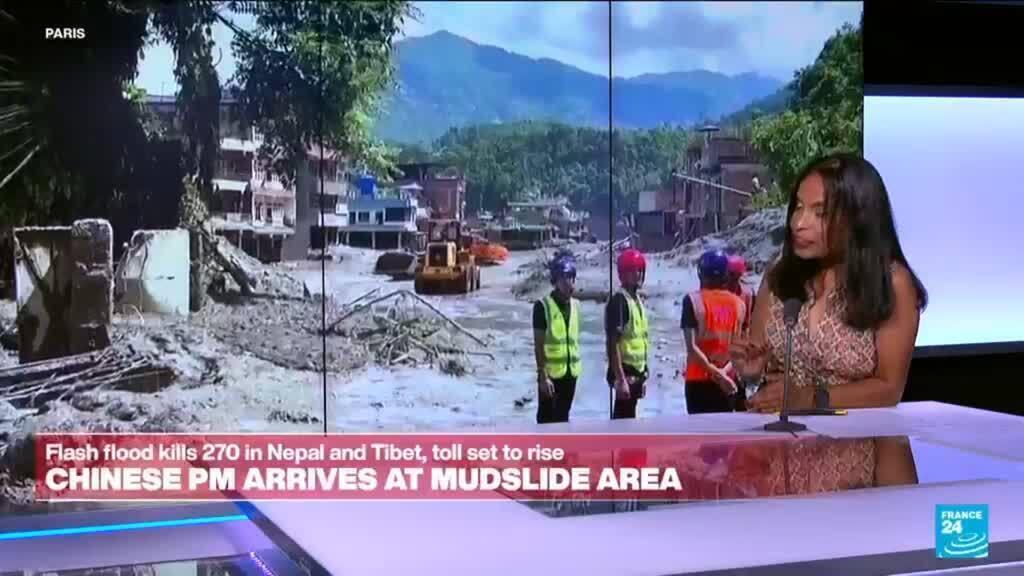
An Israeli tourist is among the hundreds still missing after a catastrophic flood in Nepal, with the death toll nearing 300, according to tourism officials. At least 65 US citizens are also missing in the disaster, which saw a wall of mud and rock collapse into a Himalayan river. The Nepal tourism board has reported that around 570 tourists, from 33 countries, are currently missing in Tibet's Gyirong county.
ZAKA, an organization investigating the disappearance, has confirmed the case of one Israeli national who has not been heard from since the incident. Israel's Foreign Ministry has warned citizens against traveling to the region due to the ongoing natural disaster. The total number of foreigners missing in the disaster is 517 from 33 countries, with 260 of them from Tibet's Gyirong county, as stated by state broadcaster CCTV, though nationality details were not immediately available.
India had the highest number of missing individuals, with 288 reported missing, according to the Indian foreign ministry. However, later reports indicated that 288 Indian nationals are missing in Nepal, along with an additional 200 stranded in China. The 288 missing included both tourists and Indians working in Nepal, according to the Indian foreign ministry.
Nepal's police have found 270 bodies after the flood, with nearly 1,500 people still unaccounted for in both Nepal and China's Tibet. The disaster has been linked to climate change, which experts say creates conditions that can destabilize high-mountain rock and ice, increasing the risk of such disasters. Simon Cox, chief scientist at the Mountains to Sea program at Earth Sciences New Zealand, explained that this can lead to collapses and cascading hazards like the one witnessed in the Himalayan flood.
Although the exact cause of the disaster is still under analysis, it is believed to have started with a massive ice-rock avalanche on the northern slopes of Nepal's Langtang Lirung peak, which then flowed into the Lhende Khola river on the Tibetan side. The event damaged at least six major hydropower plants and infrastructure at the Gyirong Port trade hub and altered river channels over 100 km (62 miles) downstream, near the Indian border.
Written by urgent.news from Jerusalem Post's reporting — not their text. Machine-written — may contain errors; check the original before relying on it.
This story
This is one outlet's version. Read the fullest account.
- 55 Ukrainian citizens reported missing following flood and landslide in Nepal – Foreign Ministry en.interfax.com.ua
- Nepal flood disaster: 353 killed, 1,300 missing israelnationalnews.com
- Rescue efforts underway after flash flood in Nepal kills over 160 mainichi.jp
- Catastrophic Nepal, Tibet flood death toll soars as 25 Canadians still missing globalnews.ca
- VIDEO | ‘I am so grateful’: Terricia Govender’s birthday video before Nepal flood disappearance iol.co.za
- Israeli among hundreds still missing in Nepal after catastrophic flood, death toll nears 300 jpost.com
- A terrifying roar, then came the fury of the flood: How disaster unfolded in Nepal theage.com.au
- A terrifying roar, then came the fury of the flood: How disaster unfolded in Nepal smh.com.au