Balkan: Bosnisch-serbischer Kriegsverbrecher Mladic ist tot
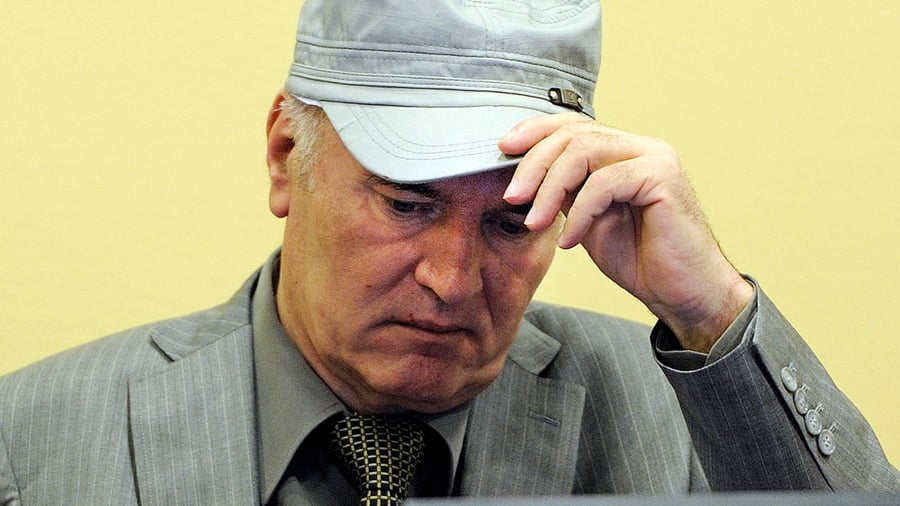
Er war einer der Hauptschuldigen der Gräueltaten im Bosnienkrieg und bekannt als „Schlächter vom Balkan“. Nun ist der zu lebenslanger Haft verurteilte Kriegsverbrecher Ratko Mladic gestorben.
Ratko Mladic, the Bosnian-Serb ex-General convicted of war crimes, has died. This was confirmed by a high-ranking UN representative to German news agency DPA. Later, a UN organization statement from The Hague said Mladic had passed away in the prison hospital on Thursday. Mladic served his life sentence for his crimes in the international prison in the Dutch city of The Hague.
The exact cause of death is still under investigation. The "butcher of Srebrenica" was responsible for the worst crime of the Bosnian war - the massacre of 8,000 inhabitants of the eastern Bosnian enclave Srebrenica, mostly men and young males, in July 1995. For this, he was sentenced to life imprisonment by the UN Tribunal for the former Yugoslavia in The Hague.
In a retrial in 2021, the successor tribunal confirmed the verdict, making it legally binding. Mladic was the commander of the Bosnian-Serb Army (BSA) during the Bosnian War. This was a civilian militia that would not have existed without the support of the Serbian leadership in the Serbian capital Belgrade. Mladic himself received his salary from Belgrade and belonged to the Serbian General Staff.
Together with the political leader of Bosnian Serbs, Radovan Karadzic, and in line with the then Serbian ruler Slobodan Milosevic, he wanted to conquer a large part of Bosnia to join it with Serbia. Karadzic also serves a life prison sentence for war crimes. Milosevic died in the Hague detention center in 2006 before the tribunal could pass a verdict on him.
Already in the first war summer of 1992, Bosnian-Serb militias under Mladic's command killed thousands of Muslims (Bosniaks) and Croats in the east and north of Bosnia. They set up prisoner camps where they held non-Serbian civilians in inhumane conditions and often tortured them. They operated rape camps for non-Serbian women and girls.
They besieged the Bosnian capital Sarajevo for more than three years, with snipers and artillerymen hunting the civilian population. Only there, more than 11,000 people died, including many children. Mladic's militias displaced hundreds of thousands of non-Serbian civilians to create "ethnically pure" areas inhabited only by ethnic Serbs.
Mladic was born in Kalinovik south of Sarajevo in 1942. At the age of almost 20, he graduated from the Military Academy in Belgrade with distinction. To the Serbs in Serbia and Bosnia, he was always a war hero. Professional Serbian television shows always depicted him as a brawny man in combat gear, always with the simple soldiers at any front.
Particularly perfidious: Serbian television filmed him in July 1995 in Srebrenica, where he distributed chocolate to children and calmed weeping women. As soon as the cameras stopped rolling, the displacement of women and children from Srebrenica began in specially prepared buses. Men and young males drove away the militia of Mladic to be shot en masse a few kilometers away in camp halls or football fields.
Mladic was only captured many years later in May 2011. The EU had made the surrender of all sought war criminals a condition for the start of EU accession talks. Mladic was eventually captured in Serbia and transferred to The Hague. The accession talks were finally started in 2014. In Serbia, the genocide of Srebrenica is still denied The official Serbia under President Aleksandar Vucic still denies the genocide of Srebrenica as determined by the UN Tribunal.
It was only a "war crime" like the other side committed against Serbs in Bosnia. Under the rug, Mladic is still glorified in Belgrade as a war hero and "savior of the Serbs". During his trial in The Hague, the ex-General showed no remorse, belittled and rambled in the courtroom. In prison, he was recently very ill. The Belgrade government tried intensively to have him released on humanitarian grounds.
His son Darko Mladic even claimed recently that his father was committing "silent murder" against him. The court decisively rejected this. Finally, on August 20, it refused his release, explaining that he was no longer transportable and his death was imminent. It was therefore more humane not to transport him again.
Written by urgent.news from Handelsblatt's reporting — not their text. Machine-written — may contain errors; check the original before relying on it.
This story
This is one outlet's version. Read the fullest account.