Scarborough Marsh in Scarborough, Maine
Scarborough Marsh looks like a simple place ruled by tides and birds. But a deeper story lies just beneath the surface of the water. Across Pine Point Road from the Scarborough Marsh Audubon Center, a short trail follows an abandoned road toward the marsh. Part of it runs alongside the remains of a canal dug during the American Revolution, built to hide ships from the British. That canal is just…
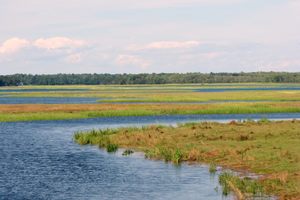
Scarborough Marsh, a seemingly ordinary location governed by tides and avian life, conceals a deeper narrative beneath its waters. Adjacent to the Scarborough Marsh Audubon Center, along Pine Point Road, a short trail traverses an abandoned road toward the marsh. This path is alongside the vestiges of a canal dug during the American Revolution, erected to conceal vessels from British forces. This canal is but one aspect of a much longer tale.
Prior to European settlers' arrival, Indigenous communities hunted and trapped in the marsh. Upon their arrival, the settlers engaged in salt hay harvesting for livestock and utilized certain marsh sections as summer pastures. By the 1800s, individuals had initiated the construction of ditches, the infill of low-lying areas, the installation of tidal gates, and the cutting of channels to alter the wetland to suit their requirements.
Subsequently, a distinct threat emerged. As hay production waned in the 20th century, wetlands began to appear more like vacant expanses of minimal worth. Suggestions arose to designate the marsh as a site for the town's landfill. However, the Maine Department of Inland Fisheries and Wildlife commenced the acquisition of land in the late 1950s, marking the initial step toward its preservation.
At present, the state owns this 3,000-acre expanse, encompassing tidal creeks, salt marshes, freshwater wetlands, and uplands.
A haven for birdwatchers and nature lovers, the marsh is an integral part of the Atlantic Flyway, a migration pathway traversed by millions of birds. Among the species that can be observed are egrets, herons, glossy ibises, shorebirds, raptors, muskrats, mink, otters, and deer. Positioned at the confluence of four rivers and numerous creeks, the marsh is also a favored gathering spot for fishing and crabbing.
Two oyster farms operate within its boundaries. Visitors can embark upon a canoe or kayak journey from the Audubon Center, and seasonal rentals are available during the center's operational hours. For those in search of a natural retreat, the marsh offers a landscape that appears untamed; however, with a keen eye, one can identify remnants of past endeavors to domesticate it for those who are cognizant of their existence.
Written by urgent.news from Atlas Obscura's reporting — not their text. Machine-written — may contain errors; check the original before relying on it.