Using thunderquakes to X-ray earth – a new study shows urban seismology in action
When lightning strikes, it superheats the air around it and creates a shock wave that we hear as thunder. When that energy reaches the ground, some of it is converted into seismic waves, and the resulting vibration is a thunderquake
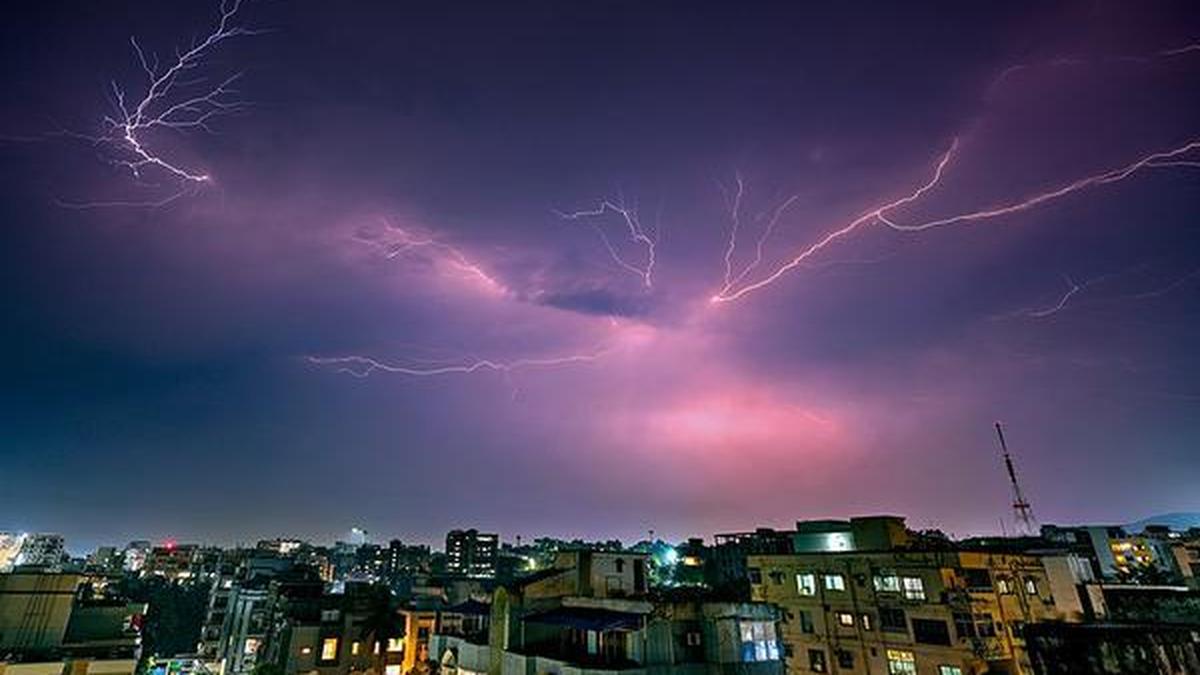
When lightning strikes, the air around it is superheated and generates a shock wave that we perceive as thunder. However, thunder doesn't only travel through the atmosphere; some of the energy from the strike is transformed into seismic waves that propagate through the ground. These vibrations, termed thunderquakes, have not been fully explored until recent research demonstrated their potential to map the Earth's subsurface much like X-rays reveal the human body's interior.
Our team discovered that thunderquakes could map groundwater movement, environmental contamination, sinkholes, and building site evaluations. This was made possible by utilizing fiber-optic cables, commonly found in internet and phone services, as thousands of vibration sensors. Distributed acoustic sensing, a technique employed in our experiment, transformed an ordinary fiber-optic cable into a network of sensors spaced a few feet apart over a 2-mile (over 4-kilometer) length.
In a two-year study, we recorded 458 clear and high-quality thunderquakes, unveiling specific types of seismic waves that result from sound from the atmosphere interacting with the ground. These air-coupled Rayleigh waves are measurable on the surface but can probe the subsurface far below, even up to 300 feet (around 100 meters).
Seismic dispersion plays a crucial role, as waves of different frequencies travel at varying depths. By measuring how the thunderquake’s wave speeds changed with frequency, we reconstructed the seismic wave speed at different depths, creating an 'X-ray' of the subsurface extending roughly 300 feet underground without drilling any holes.
This method outperformed traditional seismic techniques, which require specialized equipment and are expensive and difficult to deploy over large areas. Thunderstorms naturally emit seismic energy, spread across the landscape. By listening to the storms overhead, we can monitor the shallow subsurface continuously using existing infrastructure and atmospheric seismic energy.
In State College, Pennsylvania, where the research was conducted, the geology consists mainly of limestone and dolomite, which can slowly dissolve due to groundwater, creating fractures, caves, and sinkholes.
The study identified four weak zones where seismic waves traveled significantly slower than the surrounding rock, coinciding with areas showing ground subsidence on satellite radar. These weak zones may be due to fractured or weathered rock or the presence of water or air. Understanding these weak zones is crucial as karst landscapes cover roughly 20% of the world's continental land area, affecting nearly a quarter of the global population.
Such hazards as sinkholes, groundwater contamination, and infrastructure threats can be better managed with this knowledge.
The research illustrates a fundamental process: sound waves in the atmosphere can be converted into useful seismic waves in the solid Earth. However, thunder is just one example. Sonic booms, volcanic eruptions, and meteor airbursts can also produce similar atmospheric shock waves, potentially serving as other natural seismic sources.
This technique may even be applicable beyond Earth. Earth-like tectonic earthquakes are unlikely on some other planets and moons, but atmospheric disturbances could still provide alternative ways to investigate their subsurface. For instance, Titan, Saturn's largest moon, may generate thunderstorms that could be harnessed for subsurface exploration.
On Earth, the atmosphere constantly interacts with the ground, and our study suggests this interaction could offer valuable insights into the hidden world beneath us. Nolan Roth of The Ohio State University and Tieyuan Zhu of Penn State authored this research, which has been republished by The Conversation via PTI.
Written by urgent.news from The Hindu - Sci-Tech's reporting — not their text. Machine-written — may contain errors; check the original before relying on it.
This story
This is one outlet's version. Read the fullest account.
- Thunderquakes enable seismic imaging of Earth's shallow subsurface phys.org
- Using thunderquakes to X-ray Earth – a new study shows urban seismology in action theconversation.com
- NASA-led study shows some Earth microbes could survive on the moon japantimes.co.jp
- Using thunderquakes to X-ray Earth – a new study shows urban seismology in action hindustantimes.com