NASA’s New Space Telescope Is Poised to Discover Hidden Facets of the Universe
The Nancy Grace Roman Space Telescope is expected to discover as many as 200,000 new planets and reveal details about the elusive nature of dark matter and dark energy.
The upcoming Nancy Grace Roman Space Telescope, set to launch on August 30 from NASA's Kennedy Space Center in Florida, aims to reveal new dimensions of the universe. With a resolution rivaling that of the Hubble telescope and a field of view 100 times larger, Roman promises to uncover hidden facets of the cosmos. Dr. Julie McEnery, NASA's senior project scientist for the space telescope, predicts that the observatory will discover rare, unusual, and even surprising celestial phenomena.
During its five-year mission, Roman will meticulously map expansive regions of space to construct a comprehensive picture of galaxies and dark matter. By measuring the subtle distortions of light caused by gravity, scientists will gain insights into how cosmic structures evolve over time under the influence of dark energy, the force driving the universe's accelerating expansion.
Roman's advanced technology is expected to identify up to 200,000 new planets, potentially doubling the current count of confirmed exoplanets, which stands at around 6,300. The telescope will observe these worlds as they obstruct some of their host stars' light, and its high sensitivity will enable it to detect an additional 1,000 planets by measuring their gravitational influence on starlight.
Though the telescope's capabilities are vast, the most exciting discoveries may yet be unknown. "The most exciting science from Roman," says Dr. McEnery, "may well be something that we can't even imagine now."
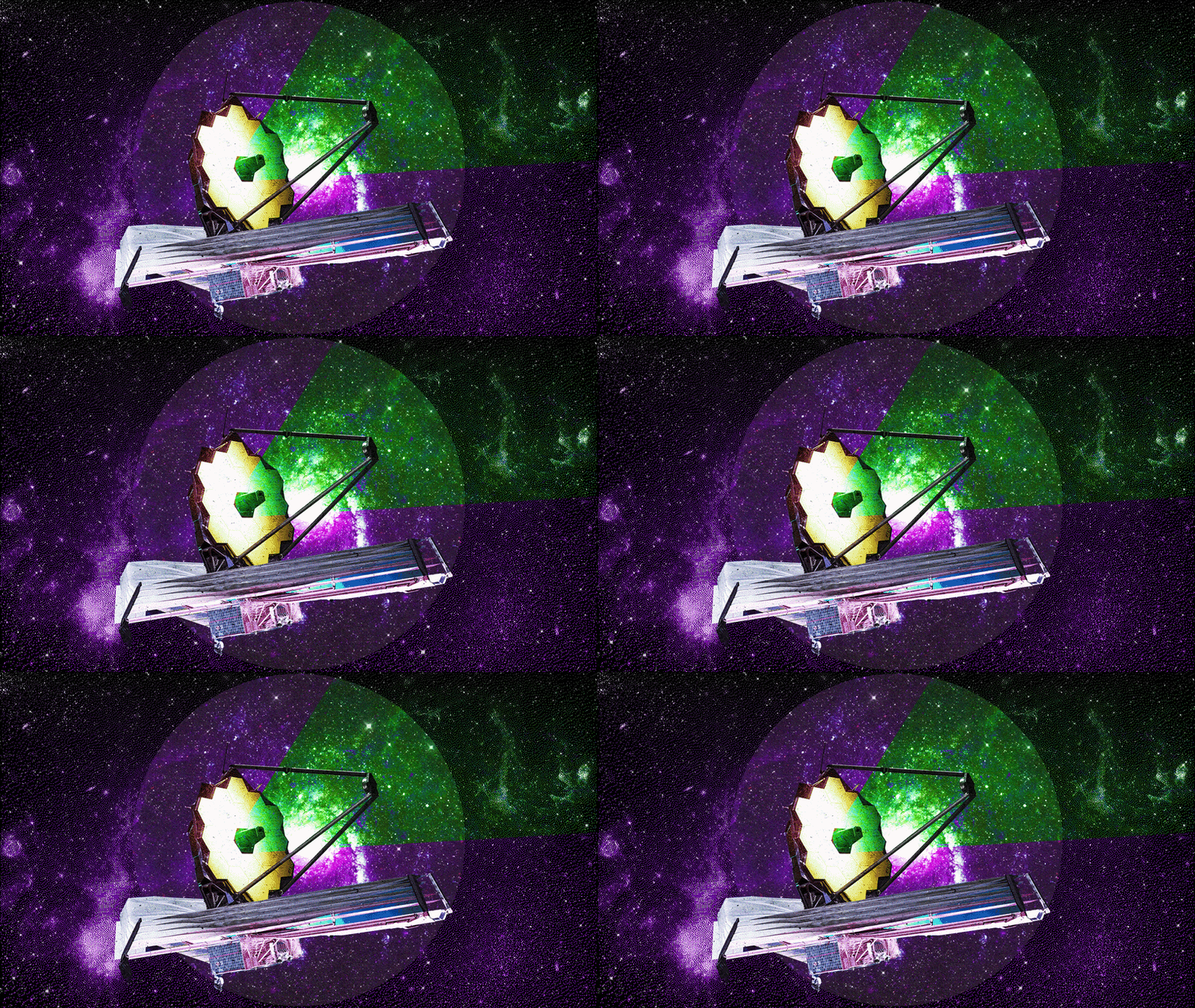
Compared to the James Webb Space Telescope, which specializes in observing distant cosmic events, Roman offers a broader perspective. While Webb focuses on a single patch of the sky, Roman will survey a larger area simultaneously. This will allow Roman to scan hundreds of millions of stars in search of planets, employing a technique called microlensing to detect planets that are farther from their stars than other methods.
Roman's sensitivity to microlensing effects will enable it to discover planets with a mass lower than Mercury and even detect rogue planets that have been expelled from their stars or formed independently in the cosmos. By studying these new populations of planets, scientists can better understand the conditions that may give rise to a system like our own, potentially including a life-sustaining planet like Earth.
Written by urgent.news from Wired's reporting — not their text. Machine-written — may contain errors; check the original before relying on it.