Urgent.News

What's breaking now, across thousands of outlets.

Science

Foreign tariffs made U.S. whiskey cheaper... depending on where you live

A new study finds that one side effect of Trump-era trade wars has been cheaper whiskey in much of the United States. But if you live in whiskey hubs Kentucky or Tennessee, your prices actually went up.

Foreign tariffs made U.S. whiskey cheaper... depending on where you live

In 2018, the Trump administration imposed tariffs on U.S. whiskey exports, sparking a trade war with major trading partners. In response, Mexico, the EU, Canada and China imposed tariffs on U.S. whiskey, reducing demand for domestic production. This led U.S. whiskey producers to decrease prices to boost domestic sales. However, the impact on consumers varied significantly by location.

In most states, whiskey prices either stayed the same or rose slightly. But in the whiskey hubs of Kentucky and Tennessee, prices actually increased. These states produce the majority of whiskey consumed in the U.S., and consumers were willing to pay a premium for locally made products. Aging constraints prevented producers from quickly adjusting supply in response to lower exports.

Instead, they adopted a dynamic pricing model, favoring price adjustments over production changes. This study highlights how political tensions and trade disputes can disrupt domestic industries, and how the effects on consumers can differ widely across regions.

Written by urgent.news from Phys.org's reporting — not their text. Machine-written — may contain errors; check the original before relying on it.

Read the original at phys.org →

More in Science

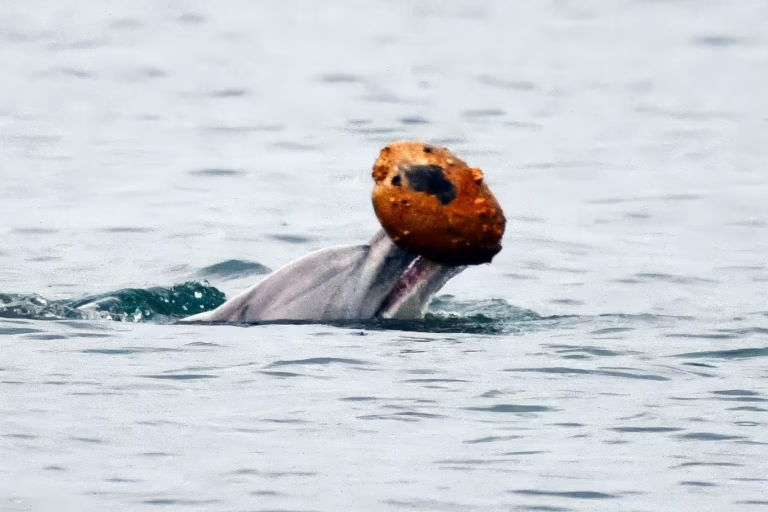
Dolphin mother and calf observed using shells to catch fish in Australia

A small population of dolphins in Shark Bay in Western Australia have a documented history of using an unusual tool to help them catch fish: Large, empty snail shells. For the first time, scientists have now observed the same behavior in a different dolphin population on Australia’s east coast. Researchers even filmed a baby dolphin […]

Samuel Kim

NASA Ames Research Center Contact email: sam.kim@nasa.gov phone: 650-604-4384 The post Samuel Kim appeared first on NASA Science .

The world's first 'space telescope rescue mission' has failed. The US National Aeronautics and Space Administration (NASA) announced on the 24th that it had given up on the 'Servicing Mission 4' to rescue the Hubble Space Telescope. The 'Servicing Mission 4' was a spacewalk repair mission that was launched on December 19 last year. The space shuttle Endeavour carrying a crew of seven astronauts, including veteran astronaut Joe Gibbs, who had previously performed spacewalk repairs on the Hubble Space Telescope four times, was dispatched. However, on the 24th, NASA announced that due to a malfunction in the shuttle's robotic arm, the mission had failed. The robotic arm, which was crucial for capturing the Hubble Space Telescope, had malfunctioned, making it impossible to approach the telescope. As a result, the seven astronauts on board, including Joe Gibbs, were forced to return to Earth without completing the rescue mission. The Hubble Space Telescope, launched in 1990, has been in operation for 16 years, exceeding its initial planned lifespan of 15 years. NASA had planned to extend its lifespan through this rescue mission. However, with this failure, the Hubble Space Telescope's future operations have become uncertain. The European Space Agency's (ESA) 'Gaia' spacecraft and NASA's 'James Webb Space Telescope' are scheduled to be launched in 2013 and 2014, respectively. These next-generation space telescopes are expected to replace the Hubble Space Telescope. However, there is still a possibility that the Hubble Space Telescope may continue to operate. NASA plans to closely monitor the situation and make a final decision on the future of the Hubble Space Telescope.

More from Wednesday 19 August →