MOTHRA Shows Us A Star Being Recycled in the Helix Nebula
Astronomers used new MOTHRA telescope in Chile to image the famous Helix Nebula. They found 22 glowing shock waves where stellar debris from a dying star collided with interstellar gas. After colliding with gas, stellar fragments remain intact for just 10,000 years, the team estimates. The observations show how dying stars are recycled and return material to the interstellar medium to form new…
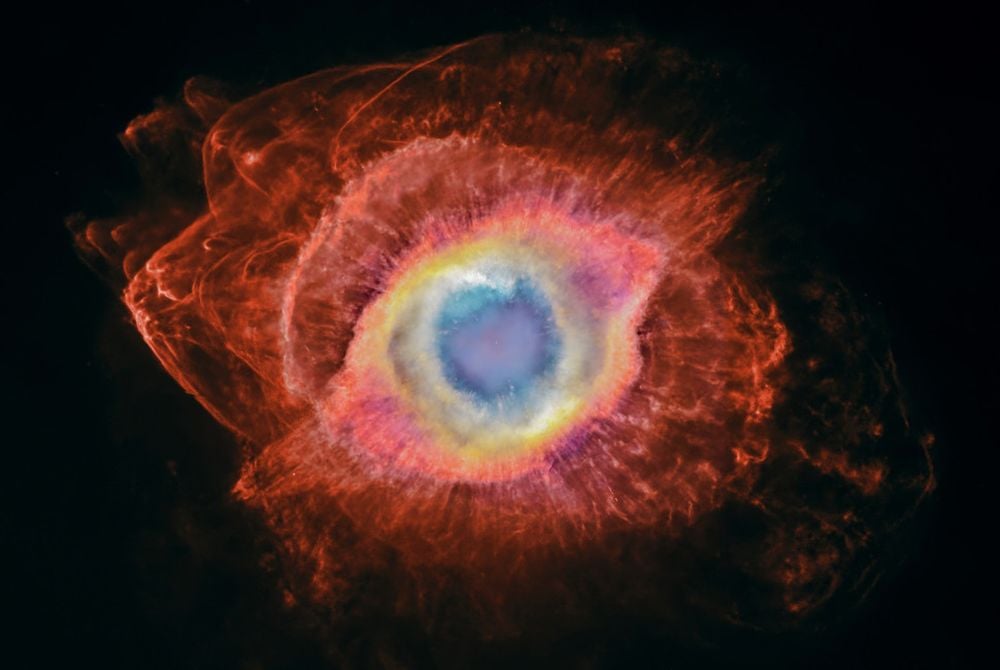
An enigmatic star is undergoing a transformation within the Helix Nebula, as revealed by the latest observations captured by the MOTHRA telescope. This unique telescope, comprised of 1,140 high-quality Canon telephoto lenses, has provided astronomers with unprecedented detail of the nebula's outer regions, where it has discovered 22 previously undetected bow shocks.
The Helix Nebula, a planetary nebula located approximately 650 light years away, is a remnant of a star's final stages of life. As low-mass and intermediate-mass stars exhaust their fuel, they eject metal-rich material in an outward flow, ultimately creating planetary nebulae. The ejected material gradually mixes into the interstellar medium (ISM), a process that has been challenging to observe directly.
The MOTHRA observations have revealed that bow shocks are present on a very small scale, near the nebula's center. These shocks, which change dramatically as they move away from the central star, are thought to result from the progressive stripping and fragmentation of the star's outer layers as they interact with the ISM. The geometric changes in the bow shocks, as well as a systematic morphological transition, suggest that the dense remnants of the star's envelope are being recycled and assimilated into the surrounding material.
This groundbreaking research, published in the journal Nature, sheds new light on the intricate processes that govern the recycling of stellar material within planetary nebulae. By observing these bow shocks at such a close range, astronomers have gained a deeper understanding of the complex interplay between dying stars and their surrounding environments, ultimately contributing to our knowledge of the cosmic cycle of life and death.
Written by urgent.news from Universe Today's reporting — not their text. Machine-written — may contain errors; check the original before relying on it.