Hubble, James Webb team up to capture the 'Black Eye Galaxy' | Space photo of the day for Aug. 18, 2026
The "Black Eye Galaxy" is captured in a gorgeous new composite image from the Hubble and James Webb space telescopes.
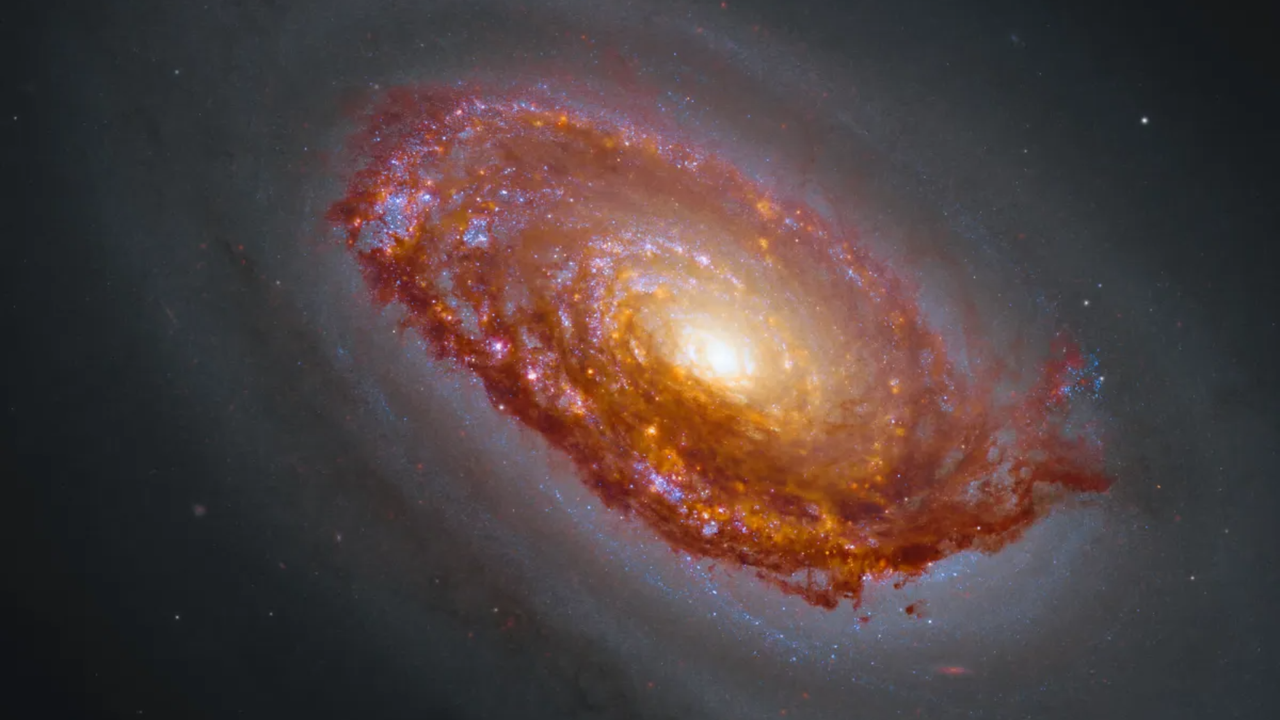
The Black Eye Galaxy, also called Messier 64, is a captivating spiral galaxy situated 17 million light-years away in the constellation Coma Berenices. Discovered in 1779, this isolated galaxy is renowned for its eerie gaze, which is a result of its internal, swirling motion. Unlike many other spiral galaxies, the outer gas in the Black Eye Galaxy rotates in the opposite direction to the gas and stars near its center, creating a unique and mesmerizing motion.
To capture the intricate details of this celestial wonder, astronomers combined near and mid-infrared observations from the James Webb Space Telescope with ultraviolet, visible, and near-infrared data from the Hubble Space Telescope. This collaborative effort of two powerful space observatories showcases how different instruments complement each other's capabilities, rather than replacing one another.
As we eagerly anticipate observations from NASA's forthcoming flagship space telescope, the Nancy Grace Roman Space Telescope, this joint project highlights the importance of using multiple advanced tools to reveal the full beauty and complexity of the universe. While the Black Eye Galaxy is a popular target for both professional astronomers and amateur stargazers alike, its distinctive appearance can often be observed with small telescopes, making it an accessible and intriguing object for all sky enthusiasts.
Written by urgent.news from Space.com's reporting — not their text. Machine-written — may contain errors; check the original before relying on it.