Water can survive surprisingly close to the Milky Way's supermassive black hole, James Webb Space Telescope finds
Water and cosmic dust can survive in the harsh environment near Sagittarius A*, new observations reveal.
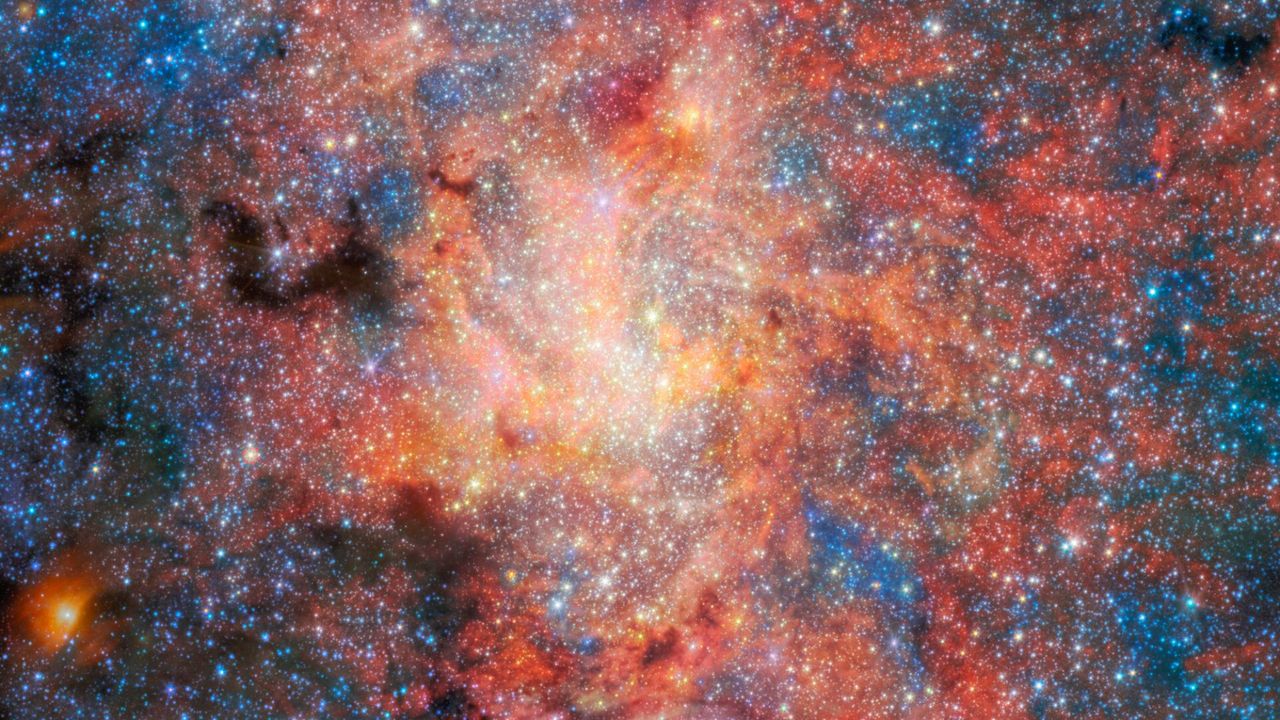
An aging star, IRS 3, has been discovered orbiting the supermassive black hole at the center of the Milky Way, Sagittarius A*. Using the James Webb Space Telescope, scientists found evidence of water and cosmic dust surrounding IRS 3, which is located just 0.55 light-years away from Sgr A*. The team utilized the Mid-Infrared Instrument (MIRI) on Webb to study the star and its environment, revealing that water and dust can not only survive, but thrive in conditions that would typically destroy them.
The findings suggest that aging stars can continue enriching their surroundings, even in the harsh conditions near the galactic center. This is important because molecular material is a key ingredient in the chemistry that drives star and planet formation. As the star shed its outer layers, it created a layered, shell-like distribution of silicate dust that extends roughly 10,000 astronomical units from the star.
While the exact amount of water present remains unknown, the detection confirms that water can persist in an environment dominated by intense radiation. The study highlights the role aging stars play in recycling material in the centers of galaxies, providing fresh dust and molecules for future generations of stars and planets.
Written by urgent.news from Space.com's reporting — not their text. Machine-written — may contain errors; check the original before relying on it.
Also reported by 4 other outlets
- Water and Dust Found Surviving near Milky Way’s Central Black Hole sci.news
- 'Especially Exciting': JWST Finds Water Surviving Surprisingly Close to Our Galaxy's Supermassive Black Hole sciencealert.com
- Space travel doesn't affect the strength of heart muscle cells, study finds phys.org
- Telescope Spots Two Black Holes on the Cusp of Merging nytimes.com