Water and Dust Found Surviving near Milky Way’s Central Black Hole
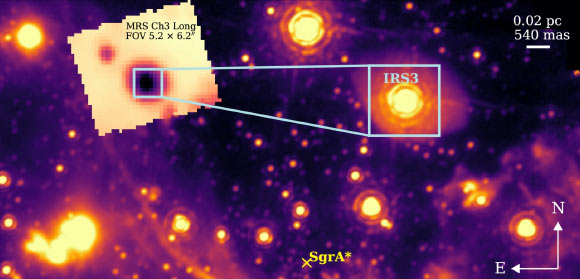
Using data from the NASA/ESA/CSA James Webb Space Telescope, astronomers found that IRS 3 is still forging silicate dust and harboring water molecules despite the Galaxy’s most extreme radiation environment. The post Water and Dust Found Surviving near Milky Way’s Central Black Hole appeared first on Sci.News: Breaking Science News .
A recent study conducted by researchers from the University of Chicago and the University of Nebraska reveals that space travel does not adversely affect the strength of heart muscle cells. The findings, published in the journal npj Microgravity, provide reassurance for astronauts embarking on extended missions to the moon and potentially Mars.
Examining heart cells from five mice that spent 38.5 days aboard the International Space Station, scientists found that the contracting force of these cells' molecular motors (sarcomeres) remained as strong as that of control mice who remained on Earth. Molecular analysis showed no significant differences in the proteins comprising the sarcomeres between space-adapted mice and their ground-based counterparts, indicating that heart cells would maintain optimal function during a prolonged space journey.
Jonathan Kirk, an associate professor at the University of Chicago and co-senior author of the study, expressed satisfaction with the results. Kirk's lab focuses on cardiovascular disease and has developed advanced techniques to study heart function in frozen tissues. This research was made possible by frozen heart tissue samples collected from mice that had been on the space station, leftover from a previous project at Baylor University.
Although the study involved a small sample size and a relatively short duration compared to human experience, Kirk emphasized its importance due to mice's accelerated lifespans. A mouse's heart beats roughly 600 times per minute, equivalent to 7.5 to 10 months for a human heart. The researchers plan to investigate longer space missions, potential immune-related changes, and samples collected on the space station to rule out the effects of re-entry stress.
Written by urgent.news from Phys.org's reporting — not their text. Machine-written — may contain errors; check the original before relying on it.
This story
This is one outlet's version. Read the fullest account.
- 'Especially Exciting': JWST Finds Water Surviving Surprisingly Close to Our Galaxy's Supermassive Black Hole sciencealert.com
- Space travel doesn't affect the strength of heart muscle cells, study finds phys.org
- Telescope Spots Two Black Holes on the Cusp of Merging nytimes.com
- Water can survive surprisingly close to the Milky Way's supermassive black hole, James Webb Space Telescope finds space.com